

Can Cats Live With Birds? Safety Risks, Introductions and Keeping Them Safe
Introduction:
Can Cats Live With Birds if you already have one pet and want to bring another home? The short answer is yes, cats and birds can sometimes live in the same household, but they should never be treated as naturally compatible pets. While it is entirely possible to maintain both animals under one roof, they should not be allowed to interact freely or live without rigorous protection. A cat’s powerful, hardwired predatory instincts mean that even a seemingly calm, affectionate house cat can pose a severe risk to a bird. Successful multi-pet management relies entirely on secure housing, diligent supervision, strict physical separation, and careful, controlled introductions.
Maintaining a peaceful home requires understanding the major risks involved, recognizing cat behavioral triggers, watching for signs of avian stress, establishing a cat-proof habitat, and following rigid safety protocols during out-of-cage time. By avoiding common mistakes and focusing on reliable boundaries, you can protect your bird’s safety while maintaining a well-managed household.
Can Cats Live With Birds Safely?
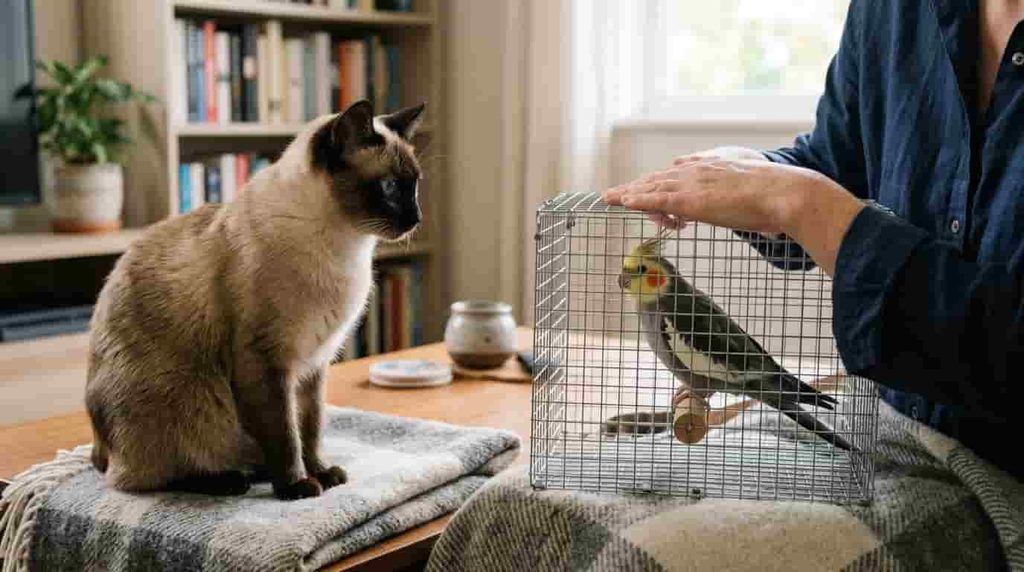
A cat and bird may share a household, but sharing a home does not mean they should freely interact. The safest arrangement gives the bird a protected area that the cat cannot access under any circumstances. Some cats may appear indifferent to birds, while others may show intense hunting behavior. Individual temperament matters, but owners should never rely on temperament alone when the safety of a fragile animal is at stake.
Same household vs. direct contact
- Bird secured in a sturdy enclosure: Lower risk, provided the enclosure is fully cat-proof.
- Cat supervised near enclosure: Requires constant caution and active human monitoring.
- Bird flying freely while cat is present: High risk of a sudden, dangerous encounter.
- Cat and bird left alone together: Unsafe and strongly discouraged.
- Cat able to reach through cage bars: Serious risk of injury or trauma.
The ultimate goal of cats and birds cohabitation should be controlled separation, not unrestricted friendship.
Why Cats Can Be Dangerous to Birds
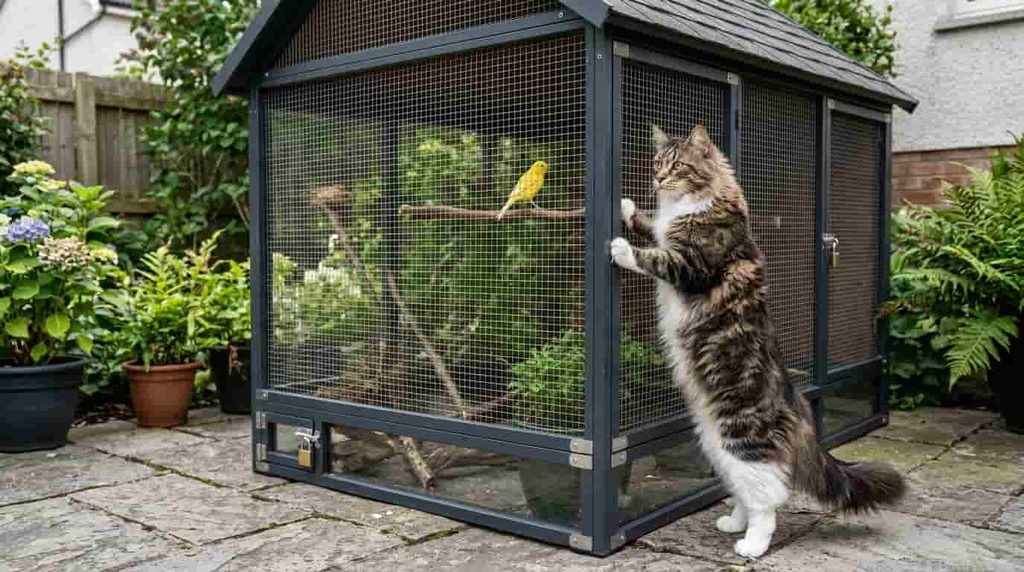
Cats have retained powerful predatory instincts inherited from their wild ancestors. Even indoor cats that have never hunted outdoors naturally engage in stalking, watching movement, chasing, pouncing, grabbing, biting, and batting at moving objects. Small, fast-moving birds can easily trigger these hardwired prey behaviors.
Why a playful cat can still cause harm
A cat does not need to be aggressive or malicious to injure a bird. Feline play behavior mimics hunting behavior; a sudden paw swipe, a playful pounce, or an overly enthusiastic grab can cause fatal internal trauma, broken bones, or deep puncture wounds. Owners should never rely on reassuring assumptions such as “my cat is gentle,” “my cat has never attacked anything,” “my cat ignores the cage,” or “my cat is scared of birds.” These observations may reflect current behavior, but they do not eliminate inherent biological risk.
Understanding Cat Behavior Around Birds
Observing cat behavior with birds allows owners to recognize when curiosity crosses the line into dangerous fixation.
Behaviors that deserve caution
- Intense staring or locking eyes on the cage without blinking.
- Crouching low to the ground with a tense, rigid posture.
- Stalking or creeping slowly toward the enclosure.
- Tail twitching, swishing, or vibrating.
- Sudden pouncing or lunging attempts.
- Pawing, scratching, or batting at the cage bars.
- Trying to climb or leap onto the enclosure structure.
- Persistent fixation or rushing toward a flying bird.
Behaviors that may look harmless
Sitting quietly near the cage, watching the bird, or showing occasional curiosity can quickly escalate if the cat becomes increasingly focused. A low-concern situation involves brief curiosity followed by immediate disengagement, whereas higher-concern situations involve repeated stalking or an inability to look away.
How Birds May React to Living With a Cat
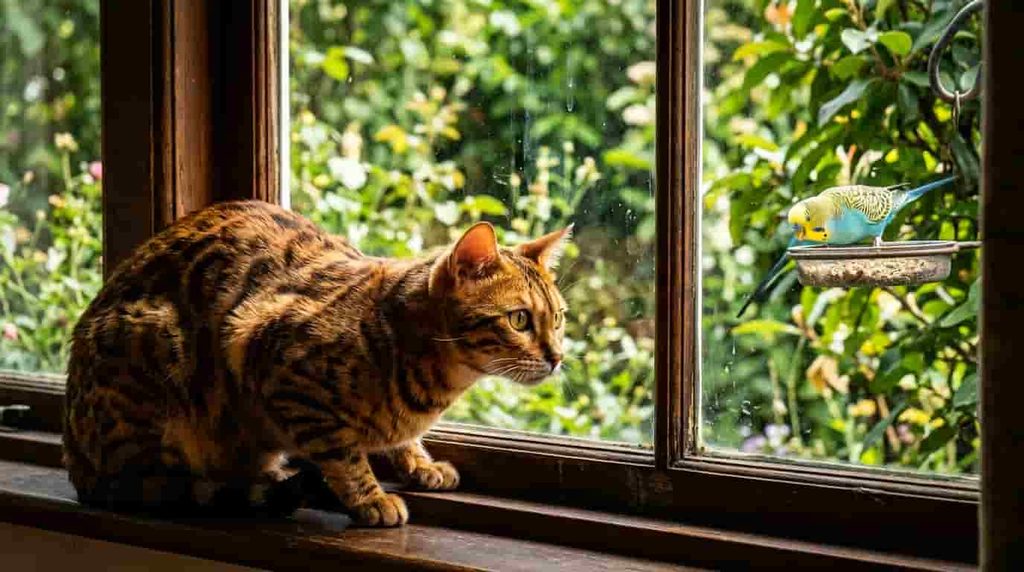
Birds are vulnerable prey animals that experience intense psychological stress when a predator is nearby. A bird may feel threatened by constant staring, a cat sitting beside its enclosure, attempts to reach through bars, sudden movements, or repeated chasing.
Signs the bird may be uncomfortable
- Hiding more often inside houses or behind perches.
- Becoming unusually quiet or unresponsive.
- Exhibiting frantic, panicked movement or flying into cage walls.
- Avoiding specific parts of the cage closest to where the cat spends time.
- Sudden changes in normal preening, eating, or vocalization routines.
- Reluctance to leave a hiding area or sleep comfortably.
Successful feline and avian coexistence requires ensuring that the bird has an environment where it feels consistently secure and hidden from predatory view.
Can Cats and Birds Live Together in the Same House?
Living together should mean occupying the same overall household while inhabiting separate secure spaces with controlled access and zero unsupervised interaction. Establishing distinct zones prevents accidental tragedies. The bird zone requires a secure enclosure, a quiet location, stable surroundings, and limited cat access. Conversely, the cat zone provides food, water, resting areas, environmental enrichment, and safe places to retreat. Physical separation successfully eliminates opportunities for chasing, cage attacks, accidental injury, escapes, and chronic stress.
How to Cat-Proof a Bird’s Cage and Living Area

Creating a cat-proof habitat is one of the most critical responsibilities for a multi-pet owner.
Choosing and positioning a secure enclosure
- Sturdy construction: Utilize heavy-duty materials with appropriate, narrow spacing between bars that prevents a cat from slipping a paw inside.
- Reliable latches: Ensure doors feature secure locks that require human dexterity to open.
- Stable placement: Position the cage on heavy, tip-resistant furniture well away from tall bookshelves, counters, or ledges that a cat can use as a launching pad.
- Avoiding high-risk zones: Never place the cage where a cat can sit directly on top of it or press its body weight against the wire mesh.
Secure all surrounding equipment, including cage stands, food containers, toys, and perches, so they cannot be knocked over or manipulated by a curious feline. Whenever possible, maintaining a dedicated bird room that the cat cannot enter provides the highest level of security.
How to Introduce Cats and Birds Safely
When introducing cats to birds in the home, patience and strict boundaries are paramount.
- Step 1: Keep them completely separate at first. Allow the bird time to settle into its new environment without any feline presence.
- Step 2: Allow distant familiarity. Let the cat become accustomed to the bird’s sounds and scents from behind a closed door.
- Step 3: Introduce visual exposure from afar. Keep the bird securely enclosed while monitoring the cat’s body language closely.
- Step 4: Keep early sessions short. End the session immediately if the cat becomes overly focused or the bird shows signs of fright.
- Step 5: Reward calm behavior. Reinforce calm disengagement rather than encouraging the cat to approach or stare.
- Step 6: Increase exposure gradually. Never rush the process simply because early sessions appear peaceful.
- Step 7: Maintain physical barriers. Even after months of calm behavior, the bird must remain protected inside its enclosure.
A successful introduction does not mean the animals should ever be left together unsupervised.
Should Cats and Birds Ever Interact Directly?

Direct interaction between a cat and a bird is inherently risky. Even if a cat seems friendly, the bird appears comfortable, and previous sessions went well, the possibility of a sudden, lightning-fast chase or grab always remains. When the bird is outside its enclosure for exercise, the cat should be securely separated behind a closed door, and the owner must control all room access. Never deliberately test a cat by placing a bird close to it to see what happens.
Can a Cat Kill a Bird?
Yes, a cat can kill a bird. The combination of rapid feline reflexes, sharp claws, and powerful jaws means a bird can suffer fatal internal trauma or severe wounds in a fraction of a second, often before a human can intervene.
If an accidental attack occurs, separate the animals immediately, handle the injured bird with extreme care, and seek prompt veterinary advice. Do not assume a bird is fine simply because external wounds look minor.
Can Birds Give Cats Diseases?
While direct disease transmission between cats and birds is relatively uncommon, maintaining strict household hygiene is essential. Regularly clean and disinfect the bird’s enclosure, prevent the cat from accessing bird waste or feathers, avoid sharing food or water bowls, and maintain routine veterinary care for both pets. If either animal shows signs of illness, consult a qualified veterinarian immediately.
What If the Cat Keeps Trying to Reach the Bird?

If a cat displays persistent fixation, identify the specific trigger—such as sudden movement, vocalizations, or cage activity. Increase physical separation by moving the cage to a restricted room, using closed doors, or establishing a dedicated bird sanctuary. Provide appropriate cat enrichment, such as interactive play, climbing trees, and puzzle feeders, to redirect hunting energy. Never punish the cat, as punishment creates fear and stress; instead, focus entirely on environmental management and barrier control.
Common Mistakes When Keeping Cats and Birds Together
- Mistake 1: Assuming a gentle cat is automatically safe. Temperament does not erase millions of years of feline predatory instinct.
- Mistake 2: Letting the cat sit on top of the cage. This terrifies the bird and grants the cat dangerous proximity.
- Mistake 3: Allowing paws through cage bars. A cat can easily inflict severe injuries without opening the door.
- Mistake 4: Leaving the bird loose while the cat is nearby. Unrestricted out-of-cage time in a cat-accessible room is an invitation for disaster.
- Mistake 5: Rushing introductions. Early success does not guarantee long-term predictability.
- Mistake 6: Ignoring the bird’s stress signals. Avian emotional well-being is just as important as physical safety.
- Mistake 7: Testing whether the animals “get along.” Deliberate close encounters create unnecessary, fatal risks.
Tips for Cats and Birds Living Together in a Multi-Pet Household
Successful multi-pet management relies on predictable routines, structured feeding times, scheduled out-of-cage periods for the bird, and vigilant door management. Giving both animals separate, secure spaces supports a harmonious living environment. Keep in mind that a previously calm cat may suddenly develop an interest in the bird following environmental shifts or routine changes, making ongoing vigilance essential.
Can Cats Be Friendly With Birds?
Some cats may appear calm, indifferent, or even learn to ignore a bird under highly controlled circumstances. However, “friendly” behavior should never be confused with safe physical interaction. The safest success is always peaceful coexistence achieved through reliable, permanent separation.
How Far Away Can a Cat Hear a Bird?
Cats possess exceptional hearing capabilities and can detect high-frequency sounds and subtle rustling from significant distances. Because a bird does not need to be physically close to attract a cat’s attention through sound and movement, owners should focus entirely on controlling access rather than attempting to calculate a safe hearing radius.
Which Animals Do Cats Get Along With?
Compatibility varies widely between individual animals. While some cats live peacefully with certain species, cats and birds require specialized management due to the undeniable predator-prey dynamic that governs feline behavior.
Related Pets: Context and Considerations
Managing multi-pet households often involves evaluating various small companion animals. For example, similar protective housing and strict boundaries are required when evaluating Can Cats Live With Rabbits? Safety, Introductions and How to Keep Them Together. Likewise, prey-drive considerations apply when reviewing multi-species dynamics in Can Cats Live With Guinea Pigs? Safety, Risks and How to Keep Them Together and Can Cats Live With Hamsters? Safety Risks, Introductions and Keeping Them Safe
FAQ: Five Additional Questions
1. Can a cat and bird ever be left alone together?
No, unsupervised direct access is never a safe arrangement and should always be avoided.
2. Can birds become stressed by cats?
Yes, the mere presence and stalking behavior of a predator-like animal can severely undermine a bird’s sense of security.
3. Can I get a bird if I already have a cat?
Yes, potentially, but only if you can provide secure, separate housing and responsible daily management.
4. How do I stop my cat from attacking my bird’s cage?
Focus on physical barriers, elevated cage placement, environmental redirection, and blocking access entirely.
5. What should I do if my cat catches my bird?
Separate the animals immediately and seek prompt veterinary care, as small animal injuries can rapidly become critical.
Conclusion — Can Cats Live With Birds?
Can Cats Live With Birds successfully? They can potentially share a household, but safe coexistence requires strict management. Cats should never have unrestricted access to birds, secure housing is essential, and introductions must remain slow and controlled. Avian stress must be taken seriously, and out-of-cage bird time should always happen safely away from the cat. Never assume a calm cat is incapable of hunting. The safest relationship is not one where animals are forced to become friends, but one where the owner prevents unsafe encounters.
How do you manage physical boundaries and multi-pet routines in your household? Share your experiences and tips in the comments below!