
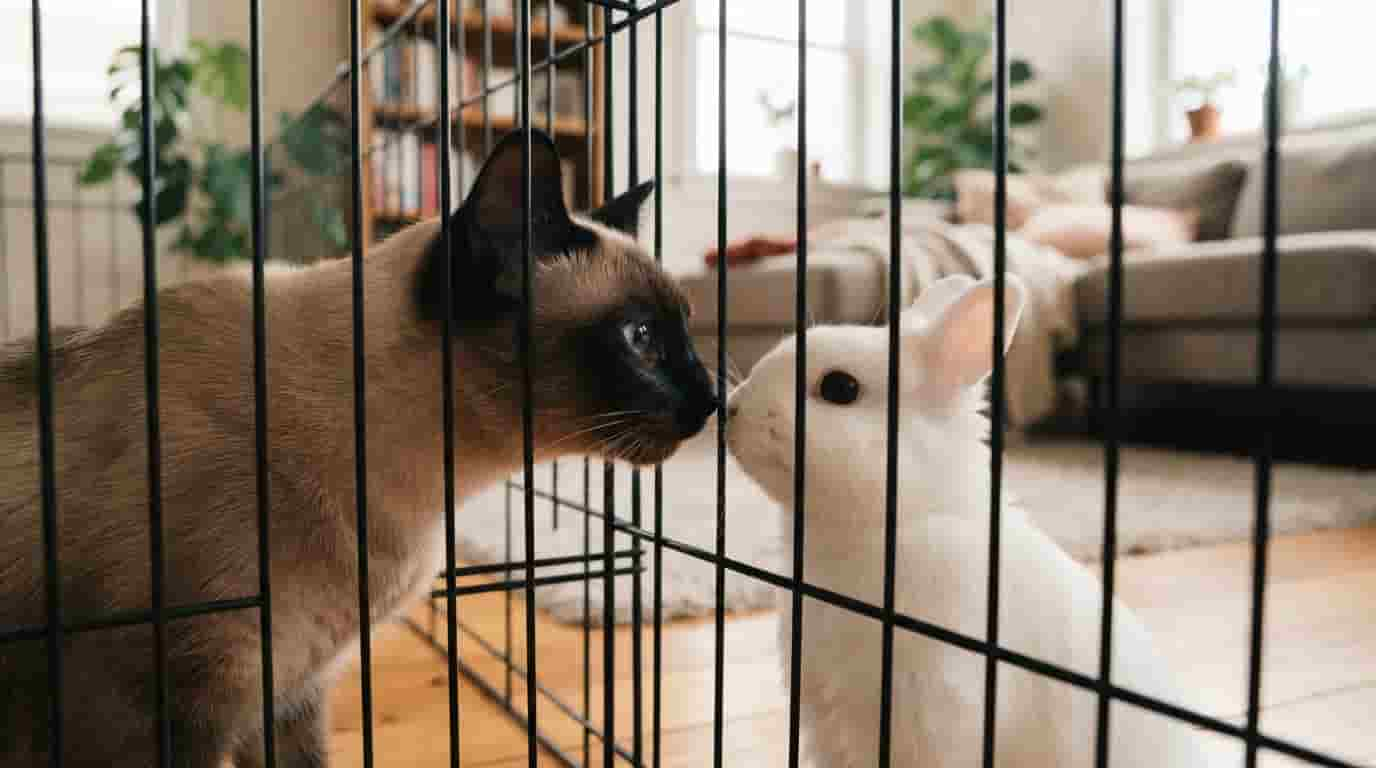
Can Cats Live With Rabbits? Safety, Introductions and Keeping Them Together
Introduction:
Can Cats Live With Rabbits if you are considering bringing a new pet into your home or trying to manage two species under the same roof? The direct answer is yes, cats and rabbits can potentially live in the same household, but compatibility varies significantly between individual animals. While some households achieve peaceful coexistence, cats inherently possess predatory instincts toward smaller animals, and rabbits can easily become frightened or stressed by a cat’s behavior. Safe cohabitation depends entirely on individual temperament, home environment, active supervision, secure spaces, and careful, controlled introductions.
Maintaining a harmonious multi-pet home requires understanding the major risks involved, recognizing feline predatory triggers, watching for signs of rabbit stress, preparing a rabbit-safe living space, and following rigid safety protocols during interactions. By avoiding common mistakes and focusing on reliable boundaries, you can protect your rabbit’s safety while maintaining a well-managed household.
Can Cats Live With Rabbits Safely?

Yes, some cats and rabbits can share a home, but that does not mean every cat is safe around every rabbit, nor does it mean direct interaction should be unregulated. Owners should never assume that a calm first meeting guarantees long-term safety. Safe coexistence requires distinguishing clearly between living in the same household—which involves separate areas when necessary, secure rabbit housing, supervised interactions, and controlled access—and being freely together, which involves unrestricted access, unsupervised interaction, and potential chasing or physical play. The latter situation carries considerably more risk and should be avoided entirely.
Determining factors for realistic cohabitation
- Cat’s prey drive: The intensity of the cat’s hunting and stalking instincts.
- Rabbit’s confidence: How easily the rabbit startles or panics in response to movement.
- Rabbit’s size and temperament: Physical proportions and personality traits.
- Ability to separate them: Availability of closed doors and separate rooms.
- Quality of enclosure: Sturdy, escape-proof housing options.
- Owner’s ability to supervise: Consistent human presence during any shared time.
Are Cats and Rabbits Compatible?

Evaluating cats and rabbits compatibility requires looking at individual personalities rather than relying on breed stereotypes. Some cats may be curious but calm, while others become intensely focused on small animals. Similarly, some rabbits remain relaxed around household pets, whereas others experience severe terror in a cat’s presence. What matters far more than breed is individual temperament, previous life experiences, prey drive, age, activity level, and environmental structure.
Compatibility checklist for owners
- Does the cat stalk small animals or outdoor wildlife?
- Does the cat chase sudden movements or shadows?
- Can the rabbit retreat somewhere secure and completely hidden?
- Can the owner separate the animals immediately if needed?
- Can every single shared interaction be fully supervised?
Why Cats Can Be Dangerous to Rabbits
Cats are domesticated companions, but they retain powerful predatory instincts inherited from their wild ancestors. Feline hunting behavior involves stalking, crouching, staring, chasing, pouncing, swatting, grabbing, biting, and batting at moving objects. A cat does not need to be malicious or aggressive to cause harm; hunting behavior often looks like play. However, a playful paw swipe or high-speed chase can easily injure a rabbit or trigger severe shock. Furthermore, a rabbit’s size does not eliminate the risk; smaller or more vulnerable rabbits are exceptionally difficult to protect during an uncontrolled encounter, and even larger rabbits can suffer severe trauma from a sudden feline attack.
Understanding Cat Behavior Around Rabbits
Observing cat and rabbit interaction closely helps owners distinguish between harmless curiosity and dangerous predatory fixation.
Signs of calm curiosity
- Brief sniffing followed by immediate disengagement.
- Relaxed body language and loose posture.
- Calmly walking or moving away from the rabbit.
Signs of predatory interest
- Intense staring or locking eyes without blinking.
- Crouching low to the ground with a rigid, tense body.
- Stalking or creeping slowly toward the rabbit.
- Tail twitching, swishing, or low-slung movement.
- Sudden lunging or pouncing attempts.
- Pawing or batting motions directed at the rabbit.
- Inability to disengage or look away.
If a cat displays intense fixation, owners should immediately create physical distance, end the interaction, redirect the cat, and increase separation. Never punish a cat for displaying natural instincts; instead, rely on environmental management.
How Rabbits May React to Cats

Rabbits are prey animals that naturally perceive cats as potential threats. When a rabbit feels unsafe, its behavior shifts dramatically. Observable signs of discomfort include hiding for prolonged periods, freezing in place, attempting to flee frantically, becoming unusually alert or hyper-vigilant, avoiding areas where the cat is visible, or showing sudden changes in eating and resting habits. A successful multi-pet relationship should never be judged solely by whether the cat avoids attacking; the rabbit must also feel secure, calm, and comfortable in its environment.
How to Prepare Your Home for Cats and Rabbits
Preparation is essential before introducing pets into a shared home. Create a dedicated, rabbit-safe zone featuring a secure enclosure, protected resting areas, multiple hiding places, and stable surroundings that exclude cat access. Simultaneously, provide the cat with its own independent resources, including food, water, elevated resting spots, scratching posts, toys, and enrichment. Utilize physical separation techniques such as closed doors and secure barriers to prevent accidental encounters. Always ensure the rabbit has clear escape routes and can move away freely without ever feeling cornered.
How to Introduce Cats to Rabbits
Introducing cats to rabbits requires a slow, structured, multi-step process.
- Step 1: Start with complete separation. Keep the animals in completely separate rooms initially so each pet can settle into its environment.
- Step 2: Let them become aware of each other. Allow them to notice sounds, smells, and ambient movement without direct contact.
- Step 3: Begin controlled visual exposure. Keep the rabbit secure while allowing the cat to observe from a safe distance.
- Step 4: Watch their body language. Ensure the cat displays a relaxed posture and the ability to disengage, while the rabbit remains calm and moves normally.
- Step 5: Keep sessions short. End the introduction before either animal shows signs of stress or fatigue.
- Step 6: Reward calm behavior. Reinforce the cat for remaining calm and turning away from the rabbit.
- Step 7: Increase contact gradually. Progress only when both animals remain consistently comfortable over multiple sessions.
Can House Rabbits Live With Cats?

House rabbits can successfully share an indoor home with cats, provided the same rigorous safety principles apply. Indoor living does not eliminate a cat’s predatory instincts, meaning an indoor rabbit still requires secure housing and protected spaces where the cat cannot reach it. Owners must control access throughout the day by maintaining predictable routines, separating spaces, supervising interactions, and providing reliable hiding areas.
Can Giant, Flemish Giant or Angora Rabbits Live With Cats?
Breed size and coat type do not guarantee safety. While larger rabbits like Flemish Giants possess more substantial physical presence, and Angora rabbits require specialized grooming and maintenance, breed size alone does not eliminate the risk of chasing, fear, or physical injury. The individual temperament of both the cat and the rabbit, along with diligent household management, matters far more than breed classification.
Can Cats Eat Live Rabbits?
A cat may display predatory behavior toward a rabbit, but owners must never allow an interaction to develop into a chase, attack, or feeding opportunity. Rabbits must never be treated as prey or hunting objects. The safest and only responsible approach is complete prevention through strict supervision and physical separation.
Should Cats and Rabbits Ever Be Left Alone Together?

Even after apparently successful introductions, unsupervised access remains deeply risky. Animal behavior can change unpredictably, a sudden movement can trigger a chase, and an unmonitored interaction can escalate into tragedy within seconds. When nobody is available to supervise, always separate the animals by securing the rabbit’s area behind closed doors. Trust the physical setup, not just past behavior.
What Should You Do If a Cat Chases or Attacks a Rabbit?
If a cat chases or attacks a rabbit, your immediate priority is separating the animals and preventing another encounter. Keep the rabbit safe in a quiet, undisturbed area. Never assume a rabbit is unharmed following an incident, as internal injuries or shock may not be immediately obvious. If the rabbit has been bitten, scratched, dropped, or shows signs of distress, seek prompt veterinary assessment immediately.
Common Mistakes When Keeping Cats and Rabbits Together
- Mistake 1: Assuming the cat is “too gentle” to hunt. Temperament does not erase biological instinct.
- Mistake 2: Letting the rabbit approach the cat freely. The rabbit should never be forced into close contact.
- Mistake 3: Allowing chasing during play. Chasing should never be dismissed as harmless entertainment.
- Mistake 4: Leaving the enclosure unsecured. The cat must never be able to enter or reach into the rabbit’s living space.
- Mistake 5: Rushing introductions. Initial peaceful meetings do not guarantee long-term compatibility.
- Mistake 6: Ignoring the rabbit’s fear signals. A quiet rabbit is not necessarily a comfortable or stress-free rabbit.
- Mistake 7: Testing the animals. Deliberately creating stressful close encounters to test reactions introduces unnecessary danger.
Tips for Cats and Rabbits Living Together

Maintaining a safe multi-pet environment relies on consistent daily management:
- Keep rabbit housing securely locked at all times.
- Actively supervise any direct visual interactions.
- Separate the animals completely whenever nobody is watching.
- Provide both pets with distinct, independent resting areas.
- Prevent the cat from accessing rabbit food or litter spaces.
- Maintain predictable daily feeding and cleaning routines.
- Offer appropriate predatory enrichment and play outlets for the cat.
- Supply the rabbit with safe, multi-exit hiding spaces.
- Monitor behavior continuously for subtle changes.
Can Cats and Rabbits Bond?
Some individual animals may achieve a peaceful status where they tolerate each other, relax in the same room, or show mild curiosity, but many others will never become close. Owners should not make friendship the primary goal. Instead, target safety, comfort, and predictable coexistence without forcing physical interaction. A positive relationship is marked by the cat’s ability to disengage easily, a relaxed rabbit, and fully controlled encounters.
Are Cats Harmful to Rabbits?

Cats can pose significant physical and behavioral risks to rabbits. The danger stems from both direct predatory behavior and the chronic psychological stress caused by a predator’s presence. Because risk levels vary widely between individual animals, secure management is always essential. Similar protective housing and multi-pet management principles are required when considering other small species, as explored in Can Cats Live With Birds? Safety Risks, Introductions and Keeping Them Safe, Can Cats Live With Guinea Pigs? Safety, Risks and How to Keep Them Together , and Can Cats Live With Hamsters? Safety Risks, Introductions and Keeping Them Safe
FAQ: Five Additional Questions
1. Can a cat and rabbit ever be left alone together?
No, unsupervised direct access is never safe and should always be prevented.
2. How do I know if my rabbit is comfortable around my cat?
Look for normal, relaxed feeding, grooming, and resting behaviors rather than simply the absence of immediate panic.
3. How do I stop my cat from chasing my rabbit?
Rely on physical separation, controlled introductions, behavioral redirection, and providing proper feline enrichment.
4. Can an older cat live safely with a rabbit?
While older cats often have lower energy levels, age alone does not eliminate natural hunting instincts or guarantee safety.
5. What should I do if my cat bites or scratches my rabbit?
Immediately separate the pets and seek prompt veterinary assessment, as small animal injuries can deteriorate rapidly.
Conclusion: Can Cats Live With Rabbits?
Can Cats Live With Rabbits successfully? They can potentially share a home, but individual temperament matters, and cats maintain inherent predatory instincts. Rabbits require secure spaces and the ability to retreat, introductions must be gradual, and direct interactions need active supervision while unsupervised access must be completely prevented. Owners should take signs of fear or chasing seriously. The safest form of coexisting is not based on assuming animals will become friends, but on thoughtful household management that protects both pets.
How do you manage physical boundaries and multi-pet routines in your household? Share your experiences and tips in the comments below!