How to Clean a Kitten’s Eyes Safely: What to Use, Infection Signs and When to See a Vet
Introduction:
Waking up to find your young feline friend with crusty, sticky, or closed eyes can be alarming for any pet owner. Seeing dried discharge or “eye gunk” clinging to delicate eyelids is a common occurrence in young cats, but knowing how to handle it correctly is vital. How to Clean a Kitten’s Eyes Safely requires a gentle touch, the right non-irritating supplies, and an understanding of when home maintenance ends and professional veterinary care begins. While a small amount of clear or slightly brownish discharge can naturally collect in the corners of the eyes from normal dust and sleeping, heavy, yellow, green, or persistent discharge often points to an underlying health concern.
Because young cats have fragile ocular tissues and developing immune systems, improper handling or using harsh chemicals can quickly turn a minor issue into a painful corneal scratch or a severe infection. In this comprehensive guide, we will walk you through everything you need to know about caring for your pet’s vision. We will cover safe, vet-approved supplies to keep in your home kit, a step-by-step cleaning procedure, how often to perform eye hygiene, and what different types of discharge signify. Additionally, you will learn how to safely handle eyelids that are matted shut, how to clean around the nose, and the critical warning signs that mean it is time to forego home care and see a veterinarian immediately.
What Can You Use to Clean a Kitten’s Eyes?
Before attempting to touch your pet’s sensitive face, gathering the correct, safe materials is critical. Using the wrong cloth or liquid can introduce bacteria, scratch the delicate cornea, or cause chemical burns to the eye surface.
Safe supplies for kitten eye cleaning
When preparing for safe kitten eye cleaning, simplicity and sterility are key. You do not need expensive medical equipment, but you must strictly adhere to hygienic materials:
- Clean, soft medical gauze pads or lint-free cloths: Standard cotton balls or low-quality paper towels should be avoided whenever possible. Cotton balls tend to shed tiny fibers that can catch on the eyelashes or float directly into the eyeball, causing mechanical irritation. Soft, non-woven gauze pads or clean microfiber cloths are ideal choices.
- Sterile saline solution: Over-the-counter sterile saline solution formulated for ocular use (such as basic contact lens rinse or eye wash without active medication or preservatives) is the safest liquid choice. It matches the natural salt balance of tears and will not sting.
- Warm, clean tap or distilled water: If sterile saline is unavailable, lukewarm water from a clean tap or previously boiled (and cooled) water is acceptable for external cleaning around the fur and eyelids. Ensure the water is never hot; test it on the inside of your wrist first.
- Multiple separate wiping pads: Always prepare several individual pieces of gauze or cloth before you start. You will need a fresh, clean piece for each pass, and never use the exact same section of cloth on both eyes.
- A soft, clean towel: Wrapping your young pet loosely in a small towel (often called a “kitten burrito”) can keep their front paws safely tucked away, preventing them from scratching at their face or your hands during the process.
What should you avoid putting in a kitten’s eyes?
Knowing what not to use is just as important as knowing what is safe. The ocular surface is exceptionally delicate, and household products can cause severe, irreversible damage. Never use the following:
- Human eye drops or redness-relieving drops: Products meant for human eyes often contain vasoconstrictors, steroids, or antihistamines that are toxic or dangerous to felines.
- Leftover prescription drops: Never apply leftover eye drops from another pet or a previous illness without an explicit veterinary examination. Using a steroid-based drop on an eye that has a corneal ulcer can cause the eye to rupture.
- Harsh soaps, baby shampoos, or disinfectants: No matter how mild a soap claims to be, cleaning chemicals should never come into direct contact with or sit near the eyes.
- Essential oils or herbal teas: Essential oils are highly toxic to cats, and home tea brews (such as chamomile tea bags) can contain particulate matter, plant bacteria, or natural compounds that trigger severe allergic keratitis.
- Homemade salt water mixes: Mixing table salt and tap water at home often results in an incorrect salt concentration (either too hypotonic or hypertonic), which burns the eye or introduces unfiltered bacteria.
It is critical to remember the fundamental distinction: cleaning the outside of the eye is purely hygienic maintenance—it is not a cure for an active eye infection.
How to Clean a Kitten’s Eyes Safely at Home
Following a structured, calm routine prevents accidental injury and ensures your pet does not build a fearful association with face handling. Here is the direct step-by-step process for how to clean kitten eyes at home.
1. Wash your hands first
Thoroughly scrub your hands with warm water and antibacterial soap for at least 20 seconds before touching your pet’s face. Human hands carry bacteria, fungal spores, and microscopic residue that can easily infect a young cat’s eye. Wash your hands again after finishing to prevent spreading potential feline pathogens.
2. Prepare everything before handling the kitten
Lay out all your supplies within arm’s reach on a stable surface before retrieving your young cat. Moisten your gauze pads with sterile saline or lukewarm water so they are ready to go. Trying to open bottles or reach for supplies while trying to restrain a wriggling, anxious pet increases the risk of accidental slips or scratches. Choose a quiet, well-lit room away from other household animals or loud noises. If you are also managing a full grooming routine for a messy or outdoor rescue, review our guide on How to Bathe a Kitten That Hates Water: Safe Steps, Age, Shampoo and Tips to keep overall stress levels as low as possible.
3. Gently hold the kitten
Place your pet on a flat surface like a table covered with a towel, or hold them comfortably on your lap. If necessary, wrap them gently in a small towel, leaving only their head exposed. Support their head firmly but gently from behind, placing your fingers under the chin and behind the ears. Never squeeze the neck, face, or throat, and never use force to pry the eyelids open if they are stuck fast.
4. Soften dried discharge
If your pet has hardened crust or “sleepy dust” along the lash line, attempting to dry-wipe or pull it away will yank out delicate hairs and tear the skin underneath. Take a gauze pad thoroughly saturated with warm sterile saline or clean water, and gently press it against the crusty area for 15 to 30 seconds. The warmth and moisture will break down the dried mucous matrix, allowing it to slide off effortlessly.
5. Wipe gently
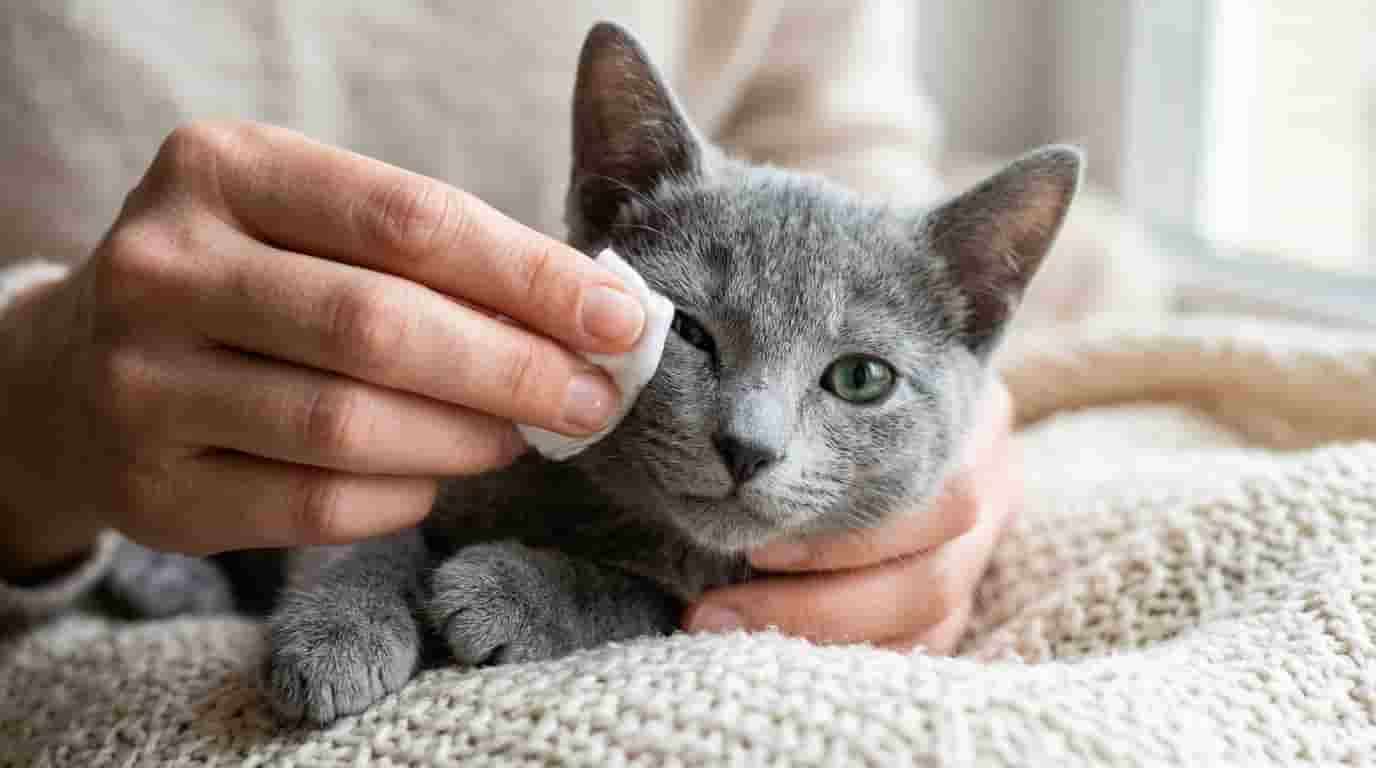
Once the crust is softened, wipe the eyelid in a single, smooth stroke. Always stroke from the inner corner of the eye (near the nose) outward toward the ear. This natural direction sweeps debris away from the tear ducts. Keep your pressure extremely light—think of it as floating the moist pad across the fur rather than scrubbing.
Simply repeat gentle strokes moving from the inner corner near the nose outward toward the ear.
6. Use a fresh piece for the other eye
Once you have made a wiping pass, throw that piece of gauze away or switch to an unused, sterile fold. If you wipe one eye and then use the exact same material on the other, you risk transferring bacterial or viral agents from an infected eye to a healthy one. Always maintain strict isolation between the two eyes.
7. Clean the surrounding fur
Discharge often runs down the facial grooves, staining or matting the cheek fur. Use a fresh damp pad to clean the facial fur beneath the lower eyelid. Gently smooth the damp hair down in the direction of natural fur growth to remove lingering crust and prevent skin inflammation (facial dermatitis).
8. Stop if the kitten becomes distressed
If your pet begins frantically struggling, vocalizing loudly, or pulling away, stop immediately. Forcing the issue creates severe anxiety, making future medical care or eye hygiene nearly impossible. More importantly, a thrashing pet can easily push against your fingers, causing accidental ocular trauma. If the eye appears painful or the animal strongly resists, pause and contact a veterinary clinic for professional support.
Should I Wipe My Kitten’s Eyes?
It is entirely reasonable to gently wipe away small, occasional specks of clear or dry brown debris from the corners of your pet’s eyes. In fact, basic kitten eye maintenance helps prevent minor debris from building up and creating skin scalding along the lower eyelids.
However, a clear distinction must be made between basic hygiene and underlying pathology:
- When to wipe: Wiping is appropriate for occasional, minimal buildup that occurs when waking up, or after playing in a dusty room, provided the eye itself underneath remains bright, clear, open, and white.
- When wiping is insufficient: Wiping should never be treated as a primary medical remedy for recurring, thick, cloudy, yellow, or green discharge. Wiping simply removes the visual symptom sitting on the external surface—it does absolutely nothing to treat the underlying viral, bacterial, or mechanical cause inside the eye. If you find yourself wiping away heavy gunk multiple times a day, wiping alone is no longer appropriate, and closer medical attention is required.
Is It Normal for Kittens to Have Dirty Eyes?
Pet parents frequently wonder: is it normal for kittens to have dirty eyes? The answer depends entirely on the nature, color, and frequency of the discharge, as well as the appearance of the eye itself.
When minor eye discharge may not be serious
A healthy cat eye should be clear, bright, fully open, and free from surrounding redness. However, tiny amounts of discharge can be harmless under the following conditions:
- Color: Clear, watery, or slightly reddish-brown when dried (due to normal tear pigments called porphyrins).
- Volume: Tiny “crusties” strictly isolated to the very inner corner upon waking up.
- Frequency: Occasional; easily cleaned once every few days or weeks.
- Eye Appearance: The underlying eye is wide open, the whites (sclera) are white, and the cornea is transparent.
- Behavior: The young cat shows no signs of rubbing, squinting, or pain.
When dirty-looking eyes may indicate a problem
When “dirty eyes” become persistent or change in appearance, it is a clear warning sign that the ocular tissue is inflamed or infected. You should be concerned if you notice any of the following clinical signs:
- Color Changes: Thick white, creamy yellow, or green discharge indicates an accumulation of white blood cells and cellular debris, heavily pointing to a bacterial or viral upper respiratory infection.
- Squinting or Blepharospasm: Holding the eye half-closed, rapidly blinking, or keeping the eyelids tightly shut signals severe discomfort or light sensitivity (photophobia).
- Tissue Swelling and Redness: Inflamed, swollen red conjunctiva (the lining inside the eyelids) that bulges out around the eyeball.
- Corneal Cloudiness: A hazy, bluish, or milky appearance across the clear front surface of the eyeball, which can indicate fluid build-up, corneal ulcers, or internal inflammation.
- Excessive Tearing (Epiphora): Watery tears constantly overflowing down the face, leaving the facial fur permanently wet.
- Behavioral Distress: The animal repeatedly paws at its face, rubs its eyes against furniture or carpets, or hides away from light sources.
Remember: the appearance or color of eye discharge alone is not enough to diagnose a specific disease. A thorough ophthalmic evaluation by a qualified professional is always required.
How to Clean a Kitten’s Eyes That Are Matted Shut
One of the most distressing situations for a cat owner is finding a young pet whose eyelids are completely glued closed by hardened, crusty secretions. Learning how to clean a kitten’s eyes that are matted shut requires patience and absolute restraint from using force.
Do not pull the eyelids apart
Under no circumstances should you ever manually pry, pick, or peel glued eyelids apart. The dried discharge acts like an adhesive glue against delicate tissue. Attempting to force the eyelids open using your dry fingers or tweezers will strip the delicate skin off the eyelid margins, tear out eyelashes, and potentially cause catastrophic physical damage to the cornea underneath.
To safely open matted eyes without force:
- Apply a warm, moist compress to softened crusts.
- Allow time for the moisture to soak through the dried debris.
- Gently let the eyelids separate naturally as the buildup dissolves.
Soften the crust first
To safely open matted eyes:
- Soak a clean gauze pad in warm (not hot) sterile saline or warm water.
- Hold the saturated pad gently against the sealed eyelids. Apply minimal pressure—just enough to hold the moist pad in place.
- Keep the compress held against the eye for 30 to 60 seconds. The warm moisture will slowly rehydrate and dissolve the hardened mucous matrix.
- Gently wipe away the softened debris in an outward motion. If the eyelids remain glued, repeat the soaking process with a fresh warm pad. As the crust breaks down, the eyelids will slide open naturally without trauma.
Know when home cleaning is not enough
Soften and wipe the eyelids only to allow the animal to see and to assess the underlying tissue. However, if the eyes seal shut again within hours, if significant pus drains out from behind the lids as they open, or if the surrounding conjunctiva appears severely swollen and bright red, stop cleaning at home and seek immediate professional veterinary intervention.
How to Clean Kitten Eyes With an Eye Infection
Search terms like how to clean kitten eye infection are common among pet parents trying to treat sick rescues. However, it is vital to understand a key medical fact: cleaning an infected eye removes buildup, but it does not treat or cure the underlying infection.
Cleaning is an essential supportive hygiene step, but infectious agents—such as Feline Herpesvirus-1 (FHV-1), Feline Calicivirus (FCV), Chlamydia felis, or Mycoplasma—require targeted pharmaceutical medications prescribed by a veterinarian, such as topical antiviral ointments or ophthalmic antibiotics.
Never attempt to treat a suspected infection with leftover prescription drops from a previous pet, human medication, or home remedies. Using inappropriate treatments can cause permanent blindness. Furthermore, managing an active, purulent eye infection at home with simple cleaning for days on end allows the pathogen to penetrate deeper into corneal layers, risking melting ulcers or globe rupture.
Signs that an eye problem needs veterinary attention
Use this concise checklist to evaluate whether your pet requires immediate professional medical care:
- Eyelids repeatedly matting shut or swollen noticeably larger than normal.
- Thick yellow, green, or cloudy discharge oozing continuously from the eyes.
- Squinting, persistent blinking, or keeping one or both eyes tightly closed.
- The clear front surface of the eye appears cloudy, milky, hazy, or indented (ulcerated).
- The white part of the eye (sclera) or inner eyelid tissue is bright red or bloodshot.
- The animal actively rubs or scratches its face against hard objects.
- The eye appears enlarged, bulging, or sunken back into the socket.
- The young cat shows systemic illness signs: lethargy, refusal to eat, fever, or nasal discharge.
How to Clean a Kitten’s Eyes and Nose
Upper respiratory infections (URIs) in young cats often cause dual symptoms: severe conjunctivitis combined with nasal congestion and crusting around the nostrils. Understanding how to clean a kitten’s eyes and nose safely involves keeping these two anatomical regions distinct during your hygiene session.
When upper respiratory discharge settles around the face, ocular secretions easily run down into the facial folds surrounding the nose. To clean both areas effectively:
- Keep eye and nose cleaning separate: Never use the same gauze pad to clean both the eyes and the nose. The nostrils harbor dense populations of respiratory bacteria; passing a pad from the nose back to the eye can introduce aggressive pathogens to the cornea.
- Cleaning the nostrils: Use a separate gauze pad moistened with warm water or saline to gently press against hard crusts blocking the nasal passages. Allow the warm moisture to soften the mucus before gently wiping down and away from the bridge of the nose.
- Never insert anything into the nasal passages: Keep your cleaning strictly external. Do not insert cotton swabs (Q-tips), rolled tissues, or cleaning fluids into the nostril openings, as this can severely damage fragile nasal turbinates or cause aspiration.
- Monitor combined symptoms: If your young cat has both eye gunk and nasal discharge, they likely have a viral or bacterial URI. While keeping their airway and eyes clear through gentle wiping helps them breathe and smell their food, they urgently require a professional veterinary exam for systemic support.
How Often Should You Clean a Kitten’s Eyes?
Establishing an appropriate routine for caring for kitten eyes means striking a balance between keeping the face clean and avoiding unnecessary mechanical irritation.
Clean only when needed
In a healthy animal with clear eyes, routine daily eye washing is entirely unnecessary. The eye naturally cleans and lubricates itself through tear production and blinking. You should only clean your pet’s eyes when visible external debris, dried crust, or tear staining accumulates around the eyelids. Unnecessary wiping of a healthy eye can strip away the natural tear film and introduce mild irritation.
When frequent cleaning becomes a warning sign
If you are forced to clean your pet’s eyes multiple times a day because discharge rapidly reappears, this is an important diagnostic signal:
- Rapidly Accumulating Secretions: Indicates that the eyes are actively producing excessive fluid or pus.
- Underlying Pathology: Signals an active infection, irritation, or blocked tear duct rather than simple external dust.
- Action Needed: Requires professional veterinary diagnosis and prescription treatment rather than endless home cleaning.
Excessive discharge production indicates that the lacrimal glands, conjunctiva, or corneal surfaces are under active stress or infection. Rather than increasing your daily cleaning frequency indefinitely, view this as a clear signal that the underlying illness must be diagnosed and treated by a medical professional.
Common Mistakes When Cleaning a Kitten’s Eyes
Even well-meaning pet parents can make simple mistakes that lead to accidental ocular damage. Avoid these frequent errors during caring for kitten eyes:
- Using dirty or unwashed hands: Touching the face without scrubbing your hands first introduces new external bacteria into an already vulnerable ocular environment.
- Cross-contaminating eyes: Using one piece of cloth, towel, or gauze to wipe both eyes transfers viral or bacterial particles from an infected eye to a healthy one.
- Scrubbing or applying heavy friction: Rubbing back and forth aggressively across inflamed eyelids causes severe pain, bruising, and micro-tears in the delicate skin.
- Pulling off dry crusts: Attempting to pick or pull off hardened ocular gunk without soaking it first tears away living tissue and fur.
- Prying glued eyelids open: Forcing matted eyelids apart using dry force can permanently damage the corneal epithelium underneath.
- Using cotton balls or Q-tips: Cotton balls leave loose fibers trapped on the eye surface, while rigid cotton swabs present a severe puncture risk if the animal suddenly twitches its head.
- Administering human or old pet drops: Applying unprescribed medications can cause rapid corneal ulceration, glaucoma, or blindness.
- Relying on home cleaning as a cure: Assuming that wiping away infectious pus will cure an internal viral or bacterial eye infection allows dangerous diseases to progress unchecked.
How to Make Kitten Eye Cleaning Less Stressful
High stress levels can make eye care a nightmare for both you and your pet. Implementing gentle, low-stress handling strategies makes kitten eye hygiene significantly safer and smoother.
Choose a calm moment
Never attempt to perform eye hygiene when your pet is in a hyperactive state, sprinting around, or aggressively playing. Wait until they are relaxed, sleepy, or recovering from a meal. A naturally drowsy pet is far more accepting of gentle facial handling.
Keep the session short
Work efficiently. Have all your moist gauze pads prepared ahead of time so the entire cleaning process takes less than one to two minutes. Prolonged restraint creates panic and struggling.
Use gentle handling
Place the animal on a non-slip surface, or wrap them snugly in a soft blanket with only their head exposed (the “burrito” method). Hold their head gently from behind without applying pressure to the delicate throat or jawline. Speak in a quiet, reassuring, low-toned voice throughout the procedure.
Build positive associations
The moment you finish cleaning, immediately reward your pet with high-value positive reinforcement—such as a lickable cat treat, gentle chin scratches, or a favorite toy. Over time, your pet will associate facial handling with tasty rewards rather than discomfort. If you are introducing a young cat to a multi-pet household while managing their health routines, review our guide on How to Introduce a Kitten to a Dog: Safe Steps, Good Signs and Common Problems
to ensure all handling and environmental transitions remain calm and structured.
When Should You Take a Kitten to the Vet for Eye Problems?
While basic cleaning handles minor external dirt, eye issues in young cats can deteriorate with alarming speed. Prompt veterinary care is vital to preserving vision.
Seek veterinary care promptly if you notice:
- An eye that remains held tightly closed or squinched shut for hours.
- Severe swelling of the eyelids or conjunctival tissue bulging around the globe.
- Thick, profuse, yellow, green, or foul-smelling ocular discharge.
- Any visible cloudiness, blue haziness, spots, or dimples on the clear surface of the cornea.
- Signs of intense pain, such as frantic face rubbing, crying, or severe lethargy.
- Nasal discharge, coughing, sneezing, or loss of appetite accompanying eye gunk.
- No improvement after 24 to 48 hours of gentle home cleaning.
Why kittens deserve extra attention
Young cats have immature immune systems and exceptionally delicate ocular structures. Conditions like viral conjunctivitis or corneal ulcers can progress from mild irritation to deep structural damage or globe rupture in less than 48 hours. Early veterinary intervention—typically involving specific antiviral, antibacterial, or lubricating ophthalmic ointments—stops disease progression rapidly, saving your pet’s eyesight and preventing chronic complications.
A Simple Kitten Eye-Cleaning Checklist
Keep this handy reference checklist near your pet care supplies for quick step-by-step guidance.
Before Cleaning
- Scrub your hands thoroughly with soap and warm water.
- Gather sterile gauze pads (or lint-free cloths) and sterile saline (or warm water).
- Pre-moisten multiple separate gauze pads so they are ready to use.
- Have a small towel nearby in case you need to gently wrap your pet.
- Select a quiet, brightly lit room free of distractions.
During Cleaning
- Secure your pet gently without applying pressure to the neck or face.
- Hold a warm, moist gauze compress against any dried crust to soften it first.
- Wipe gently in a single motion from the inner corner outward to the outer corner.
- Use a completely fresh gauze pad for the second eye.
- Clean any external discharge sitting on the cheeks or facial fur.
- Stop immediately if your pet becomes severely distressed or agitated.
After Cleaning
- Safely dispose of all used gauze pads immediately.
- Wash your hands thoroughly with soap and water.
- Reward your pet with a high-value treat and quiet praise.
- Monitor the eyes closely over the next several hours for redness, swelling, or rapid re-accumulation of discharge.
Hypothetical Example: A Kitten With Dried Eye Discharge
To better understand how to apply these guidelines in real-life scenarios, consider the following contrasting hypothetical examples.
Scenario A: Mild External Debris (Home Care Appropriate)
Hypothetical Case: A six-week-old rescue named Oliver wakes up from a nap with a small specks of crusty, dried brownish material sitting strictly in the inner corner of his left eye. The eye itself underneath is wide open, clear, bright, and white, with no surrounding redness or swelling. Oliver is eating well, playing normally, and showing no signs of pain or squinting.
Action Taken: His owner washes their hands, moistens a sterile gauze pad with sterile saline, and gently presses it against the crust for a few seconds. The softened debris wipes away cleanly in one gentle outward stroke. Oliver continues playing happily, and the discharge does not return. In this hypothetical situation, simple home hygiene was safe, appropriate, and completely effective.
- Progression: Small dry crust $\rightarrow$ Clear eye underneath $\rightarrow$ Gentle saline wipe $\rightarrow$ Resolved with home care.
Scenario B: Active Ocular Infection (Veterinary Care Required)
Hypothetical Case: A seven-week-old kitten named Luna presents with a swollen, bright red right eye held half-closed. Thick, yellowish-green pus continuously oozes from underneath the eyelids, sticking her eyelashes together within hours of being cleaned. She keeps pawing at her face, squinting in bright light, and sneezing occasionally.
Action Taken: Her owner recognizes that while wiping away the yellow pus helps Luna temporarily open her eye, the recurring thick discharge, squinting, and tissue swelling signal an active infection. Rather than relying on continuous home wiping, the owner gently cleans the excess pus once to make Luna comfortable and immediately schedules a veterinary examination. The vet diagnoses feline viral conjunctivitis with a secondary bacterial infection and prescribes targeted ophthalmic antibiotic ointment. Within a few days of proper medication, Luna’s eye recovers fully.
- Progression: Thick yellow pus $\rightarrow$ Squinting & swelling $\rightarrow$ Wiping insufficient $\rightarrow$ Veterinary diagnosis & prescription medication required.
Frequently Asked Questions About Kitten Eye Cleaning
What can I use to clean my kitten’s eyes?
The safest material to use is sterile medical gauze or a lint-free soft cloth moistened with sterile ocular saline solution. If saline is unavailable, lukewarm clean tap or distilled water can be used for gentle external cleaning around the eyelids and facial fur. Always avoid human eye drops, soaps, essential oils, and cotton balls that leave loose fibers behind.
Is it safe to clean my kitten’s eyes with salt water?
It is safe only if you are using commercially prepared, sterile isotonic saline (0.9% sodium chloride) intended for eye use. You should never attempt to mix homemade salt water using table salt and tap water. Incorrect home concentrations will severely burn your pet’s delicate eyes and can introduce dangerous unfiltered bacteria into an already compromised ocular surface.
How often should I clean my kitten’s eyes?
You should clean your pet’s eyes only on an as-needed basis when visible external discharge, crust, or dust accumulates. Healthy eyes naturally lubricate and clean themselves and do not require routine daily washing. If you find yourself needing to wipe away heavy discharge multiple times a day, your pet likely has an underlying infection that requires a professional veterinary exam rather than repeated home wiping.
Can I use human eye drops on my kitten?
No, you should never apply human eye drops, contact lens multi-purpose solutions, or over-the-counter medicated drops to a cat’s eyes. Many human formulations contain active chemical ingredients, vasoconstrictors, or preservatives that are toxic to felines or can cause severe, painful reactions. Only use ophthalmic medications specifically prescribed by a qualified veterinarian.
What should I do if my kitten’s eye is swollen or stuck shut?
If the eyelids are matted shut, never attempt to force, pull, or pry them apart dry. Soak a clean gauze pad in warm sterile saline or water and hold it gently against the sealed lids for 30 to 60 seconds to break down and soften the crust, allowing the eye to open naturally. If the eye underneath appears bright red, cloudy, or swollen, or if thick pus oozes out, seek immediate veterinary advice rather than attempting further home treatment.
Conclusion — How to Clean a Kitten’s Eyes Safely
Learning How to Clean a Kitten’s Eyes Safely comes down to three fundamental principles: using pure, non-irritating supplies, maintaining absolute gentleness without forcing the tissue, and recognizing the critical boundaries of home care. Gentle external wiping with sterile saline and soft gauze is an excellent way to maintain facial hygiene and keep your young cat comfortable when minor crusts accumulate.
However, always remember that cleaning is a supportive hygiene measure—it is not a cure for underlying ocular pathology. If your pet exhibits persistent yellow or green discharge, cloudy eyes, severe swelling, or signs of pain like constant squinting, home cleaning alone is insufficient. Prompt evaluation by a qualified veterinarian ensures that your pet receives the accurate diagnosis and targeted prescription medications needed to safeguard their eyesight.
Has your kitten ever woken up with crusty eyes? What gentle cleaning methods worked best for you, and when did you decide it was time to consult your vet? Share your experiences and questions in the comments below!