
Cat Hunting Instincts: How to satisfy their need to kill indoor toys.
Introduction:
Cat Hunting Instincts drive almost every single daily activity of your healthy domestic companion. Do you feel frustrated when your energetic pet zooms across your clean bed rugs at three o’clock in the morning? Many indoor felines develop severe behavioral issues because their quiet home environment lacks real prey targets to track down. Therefore, learning to channel these deep Cat Hunting Instincts into structured indoor games keeps your animal remarkably peaceful.
This professional guide will examine how to satisfy the internal biological drivers that control predatory actions in felines. First, we will analyze the evolutionary history behind the specific stalking prey movements of your small domestic predator. Next, you will discover how to select dynamic gear that mimics the unpredictable flight patterns of wild targets. Finally, we will share step-by-step techniques to structure a deeply rewarding daily hunting circuit inside your apartment.
Protecting your pet requires moving past simple stationary balls to create an engaging indoor wilderness experience. Let us dive deep into the fascinating mechanics of Cat Hunting Instincts to upgrade your daily pet care style today.
Cat Hunting Instincts: Understanding the Biological Predatory Drive
Analyzing the power of Cat Hunting Instincts requires looking directly at the evolutionary biology of the African wildcat ancestor. Thousands of years of domestication have not altered the core predatory behavior in felines even slightly. Your pampered living room companion still possesses the exact same neurological wiring as a professional desert hunter. Therefore, their inner drive to stalk, chase, pounce, and bite is a fundamental requirement for total wellness.
Additionally, standard mechanical rollers fail because they do not allow your pet to complete the actual capture phase. This structural failure causes great mental frustration, which often leads to unexpected behavioral issues around the house. Many owners assume that leaving a basket of plush mice on the floor gives their pet enough exercise.
However, motionless objects do not spark the brain receptors that control the true hunting instincts of domestic cats. Without human assistance, a stationary stuffed mouse feels exactly like a dead leaf to an active feline. This sensory disconnect highlights why managing Cat Hunting Instincts remains a crucial task for every single apartment pet parent. Let us look at how the natural hunting skills of felines compare across different household scenarios.
| Hunting Phase | Primary Physical Action | Main Mental State |
| The Slow Stalk | Crouching low with slow paw placements | High focus and intense visual tracking |
| The Sudden Pounce | Explosive hind leg spring movements | High adrenaline and peak muscle engagement |
| The Final Bite | Deep jaw clamping onto the target | High satisfaction and emotional release |
The Dangerous Behavioral Consequences of Suppressed Prey Drives

Leaving natural hunting instincts of domestic cats unfulfilled can lead to severe behavioral problems inside your home. When felines cannot find birds to track, they often redirect their internal frustration toward human family members. For example, your pet might hide behind kitchen doors to pounce aggressively onto your bare ankles as you pass. This painful reaction represents a classic manifestation of misdirected predatory instincts in cats who lack sufficient daily stimulation.
Furthermore, a local pet owner named Funmi once struggled with her young tuxedo animal attacking guests. She realized that her lonely pet was simply trying to treat human movement like a fun chasing game. She read our detailed article on Cat Biting Softly: Understanding the meaning of love bites to learn about early overstimulation warnings. Providing structured hunting sessions using long string lures allowed her active pet to burn off that extra adrenaline safely.
As a result, the calm animal stopped pouncing on human skin because its predatory energy went toward appropriate fabric targets. This real-life example shows how understanding feline hunting behavior helps you build effective solutions for common household stress. Let us look at how monitoring minor physical gestures can help you track the hunting focus of your pet.
Reading Subtle Ear Vibrations to Measure Predatory Focus

Monitoring your pet’s sensory focus helps you determine if your chosen game matches their natural hunting techniques in its style. You should watch for slight muscle adjustments that show your animal is locking onto a moving object. For instance, discover our guide on Cat Ear Twitches: What those subtle ear movements actually say to analyze tracking signals. These fast micro movements prove that the cat stalking behavior is engaging the biological tracking centers of the brain.
Resolving Severe Spatial Conflicts Caused by Frustrated Energy
Suppressed energy can cause a sensitive animal to become overly defensive about its physical boundaries inside your apartment. When felines cannot satisfy their cat prey drive, they may start fighting with housemates to establish dominance. To solve these domestic arguments, read our expert advice on Cat Territory Marking: How to stop spraying inside the house today. Releasing tension through daily play reduces the urge to mark walls with territorial fluids quite dramatically.
Mastering the Art of the Flawless Indoor Toy Simulation
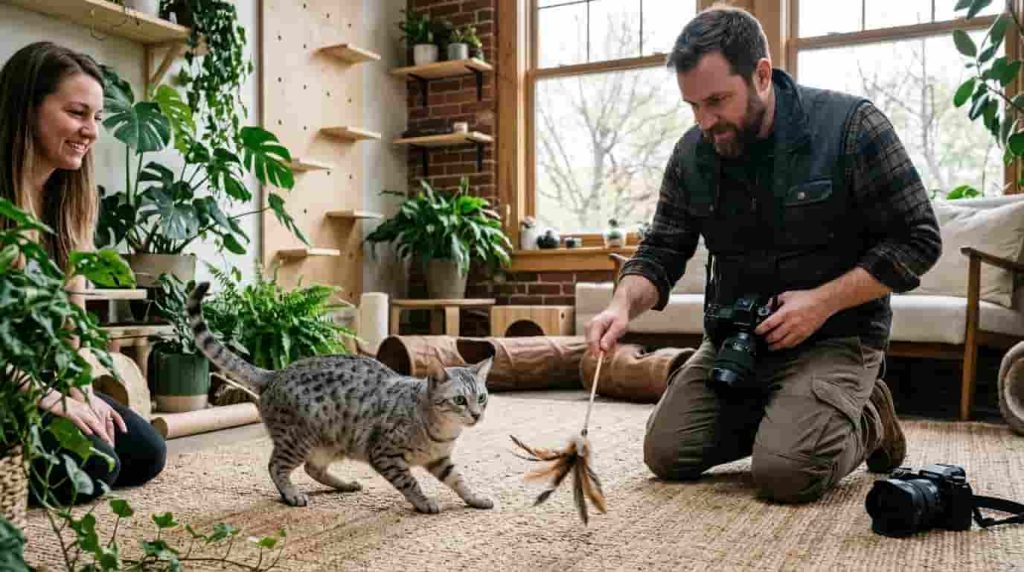
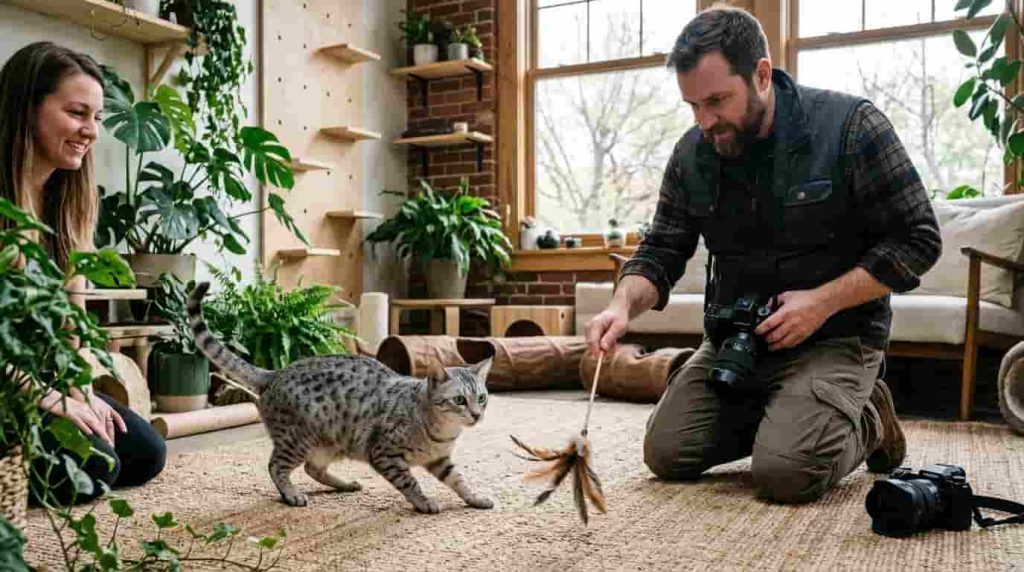
Simulating realistic prey movements requires the human parent to think exactly like an injured bird or a panicked field mouse. You must drag fabric lures slowly away from your pet rather than pushing objects directly into their face. Remember that real prey items never run toward a feline predator because survival requires fleeing in the opposite direction. Therefore, pulling a string behind heavy sofa cushions mirrors natural hunting patterns beautifully.
Additionally, vary your speeds to keep the cat chasing instincts completely activated throughout the entire session. Let the feather attachment flutter gently in the air before dropping it quietly onto the living room rug. According to clinical veterinary health handbooks published by PetMD, this mental challenge keeps feline brains healthy.
The complexity of the track matters much more to your pet than the actual speed of the chase. This slow build up creates deep satisfaction, making it the perfect way to satisfy Cat Hunting Instincts safely. Let us look at how to structure a great rewards program to finish your daily game sessions perfectly.
Building a Rewarding Play Circuit to Finish the Hunt Properly

Completing your daily feline hunting techniques circuit requires connecting the final physical capture to a delicious food reward. In the wild, successful predatory behavior in felines always ends with eating a fresh meat meal. You should replicate this natural sequence by feeding your pet immediately after they catch the toy a final time. This simple routine satisfies the evolutionary cycle of stalk, chase, kill, eat, and groom perfectly.
Furthermore, this habit leaves your animal companion feeling deeply content and ready for a long peaceful sleep cycle. Always let your pet hold the toy firmly under their paws for a few moments before ending the game. This physical contact prevents the psychological irritation associated with automated toys like uncatchable red laser pointers.
By respecting the biological rules of the hunt, you maximize the wonderful behavioral rewards of indoor play. Your careful management helps transform an anxious animal into a confident and well behaved household companion. Let us review the essential guidelines for keeping your indoor hunting gear completely safe between games.
- Store all flexible string lures inside closed wooden drawers immediately after your session ends.
- Check fabric mice regularly to remove loose plastic eyes that your pet might accidentally swallow.
- Vary the attachments weekly to prevent your animal from getting bored of the same texture.
- Keep small treats in your pocket to reward quiet stalking behaviors on the carpet instantly.
Conclusion
In conclusion, managing natural Cat Hunting Instincts remains a vital responsibility for every single indoor pet owner today. By understanding the biological predatory sequence, you can design highly effective games that satisfy their deep evolutionary drives. These structured play sessions eliminate the anxiety that causes late-night zooming behaviors and unprovoked ankle attacks.
Always offer high quality interactive toys and follow up every catch with a savory reward to complete the cycle. Your consistent dedication will help your domestic animal stay agile, healthy, and emotionally secure throughout its life. With a proper understanding of Cat Hunting Instincts, you can build a truly harmonious home for your pet.
Does your favorite domestic feline prefer stalking hidden floor strings or leaping high for airborne feather toys? Please share your funny hunting stories and drop your unique behavior questions in the comment section down below!
Frequently Asked Questions
Hunting is an internally motivated behavior circuit that operates independently of actual physical hunger inside the feline brain. Even a fully satiated pet feels a deep biological compulsion to stalk and catch moving household items.
Normal stalking involves a low body posture, flattened ears, a twitching tail tip, and a slow forward march. The animal will also freeze its body completely right before executing an explosive forward pounce onto the toy.
The best choices include long fiberglass wand lines, flexible wire feather lures, and organic catnip kicker mice. These specific items allow you to mimic the erratic movements of wild birds and mice quite realistically.
Yes, felines who lack appropriate outlets for their energy will often target moving human feet to release pent up adrenaline. You can easily fix this behavior by scheduling two ten minute interactive play sessions every day.
Evolution optimized felines to function as highly specialized solitary predators who require regular physical challenges to stay emotionally balanced. Without these challenges, indoor animals frequently develop stress related issues like over grooming or depression.