
Cat Meowing Meanings: What Your Cat Is Trying to Tell You
Introduction
Cat meowing meanings are more complex than most owners ever realize. You hear your cat call out from another room and wonder what it actually wants. The answer depends on the type of meow, the tone it uses, and the situation happening around it.
Here is something that surprises many cat owners. Adult cats almost never meow at other cats in the wild. They developed this vocal behavior specifically to communicate with humans. Therefore, every meow your cat directs at you is a deliberate and personal message.
Understanding cat language takes some practice, but the rewards are incredible. Once you start interpreting cat meows correctly, you stop guessing and start truly listening. Additionally, you begin to recognize when your cat is happy, hungry, bored, or in real pain.
This guide breaks down the most important cat vocalizations you hear every single day. It also covers the sounds most owners misread and explains what to do when meowing patterns suddenly change. By the end, you will feel confident responding to exactly what your cat is telling you.
Cat Meowing Meanings: Why Your Cat Talks Only to You

Most cat owners do not know this fascinating fact about feline behavior. Adult cats in the wild simply do not meow at each other. They use meowing almost exclusively to communicate with the humans in their lives, making it one of the most intentional forms of cat behavior communication.
According to PetMD, cats developed their unique meowing behavior primarily as a tool for communicating with people. Kittens meow at their mothers to signal hunger or fear in the early weeks of life. As they grow into adults, most cats stop using this sound with other cats entirely. However, they continue using it with people throughout their whole lives.
This tells you something very important about your cat. When your feline meows at you, it makes a deliberate choice to reach out and communicate. Therefore, understanding cat language starts with taking every meow seriously as a real and intentional message.
Furthermore, the pitch and pattern of each meow carry just as much meaning as the sound itself. A short and high-pitched meow often signals a quick and friendly greeting. A long and drawn-out meow, however, usually signals a stronger demand or a genuine complaint.
The Main Types of Cat Vocalizations and What They Mean
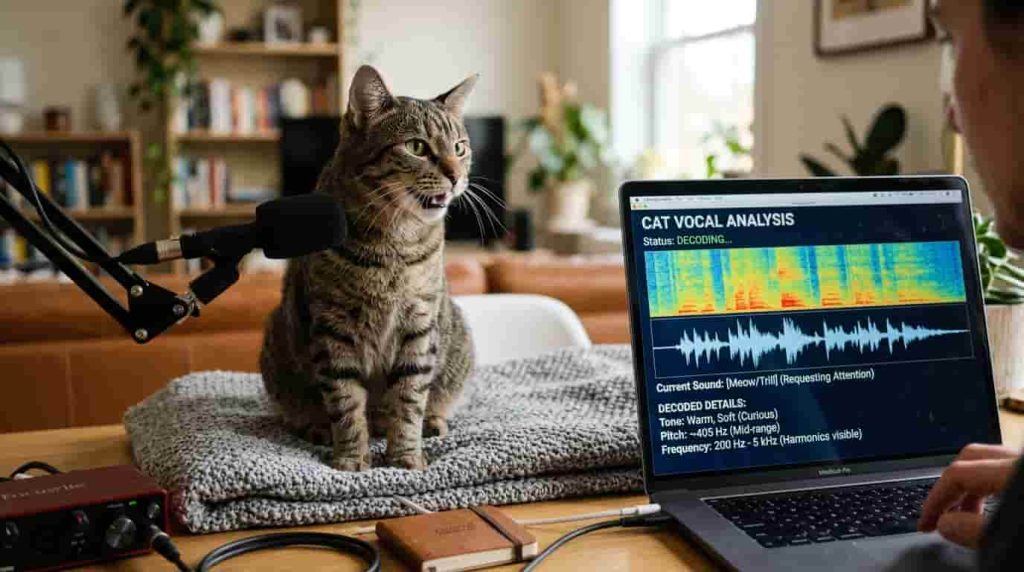
Cats produce a wide variety of sounds well beyond the basic meow. Learning to identify each one helps you respond correctly every time. Here are the most common cat vocalizations and what they typically mean:
- Short and chirpy meow: A friendly greeting your cat uses when entering the room where you are.
- Long and drawn-out meow: A demand, usually for food, attention, or access to a closed space.
- Low-pitched meow or moan: A complaint or a sign of discomfort. Always pay close attention to this one.
- Rapid and repetitive meowing: Excitement or urgency, often appearing just before mealtime.
- Chirping or chattering: Your cat spots prey like a bird outside and feels the frustration of being unable to reach it.
- Trilling: A warm and affectionate sound cats use to greet owners and companions they love.
Next, it is important to combine these sounds with what your cat’s body is doing. A meow paired with a puffed tail means something very different from a meow paired with slow blinking and relaxed ears. For the full picture on physical signals, read our guide on Cat Body Language: How to read your pet’s silent signals.
Decoding Cat Sounds by Tone, Pitch, and Frequency

The same word means different things depending on how someone says it. Cat vocalizations work exactly the same way. Therefore, paying attention to tone and pitch is essential for decoding cat meows with real accuracy.
Here is a simple guide to what tone tells you:
- High-pitched meows: Generally positive or attention-seeking. Your cat feels good and wants interaction right now.
- Mid-pitched meows: Requests or mild demands. Your cat wants something specific and is asking politely.
- Low-pitched meows or yowls: Discomfort, fear, or irritation. Take these sounds seriously every time.
- Rising meow that starts low and ends high: A question or a plea. Your cat is asking for something earnestly.
- Flat or monotone meow: Often signals boredom or mild dissatisfaction with the current situation.
Additionally, frequency matters just as much as tone. A cat that meows occasionally throughout the day is communicating normally. A cat that meows constantly and loudly, however, may be experiencing stress, illness, or cognitive changes connected to aging.
Real life example: Maria from California noticed her 12-year-old cat Luna started yowling loudly at night for the very first time. After a vet visit, she discovered Luna had developed hyperthyroidism. Catching that shift in cat sound meanings early made an enormous difference in Luna’s treatment and recovery.
Cat meowing meanings become much clearer when you track patterns over time. Keep a simple mental note of what is normal for your individual cat so you can spot changes fast.
How Context Changes Cat Meowing Meanings Completely

Context is everything when interpreting cat meows. The exact same sound can mean hunger, fear, or loneliness depending entirely on the situation around it. Therefore, always look at what is happening near your cat when it starts to meow.
Here are common situations and what the meowing most likely means:
- Near the food bowl in the morning: Almost certainly hunger. Your cat wants breakfast and wants it now.
- At the front door when you arrive home: A warm greeting. Your cat noticed your absence and is happy you returned.
- In the middle of the night: Could be boredom, hunger, or anxiety. It may also signal a health issue in older cats.
- While staring at a closed door: Your cat wants access to whatever is on the other side.
- After using the litter box: Sometimes a sign of discomfort during elimination. Check for constipation or urinary issues.
- During or after play: Normal excitement and engagement. Your cat feels energized and is sharing that energy with you.
Furthermore, some cats are simply more talkative than others by nature. Siamese cats are famous for constant and expressive cat vocalizations throughout the day. Understanding your individual cat’s normal baseline helps you notice meaningful changes quickly.
Also, nighttime yowling often connects to high energy levels and hunting instincts that kick in after dark. Learn more about this in our article on Cat Night Zoomies: Why your pet runs wild at 3 AM.
When Feline Vocal Cues Signal a Health Problem
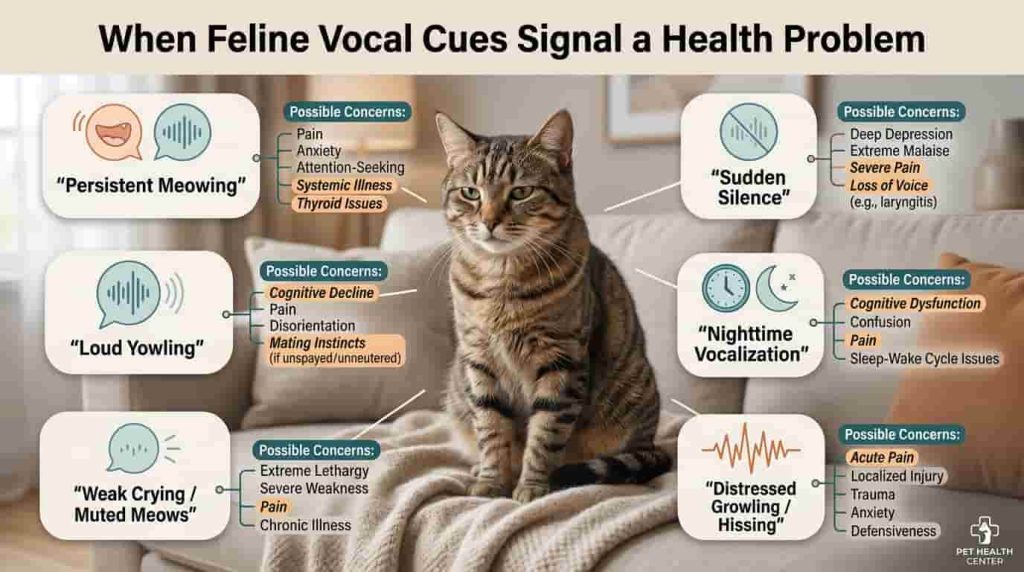
Sometimes a change in meowing is not about hunger or attention at all. It is actually a sign that something is medically wrong with your cat. Therefore, knowing the warning signs helps you catch health problems before they become serious.
Watch for these red flags in your cat’s vocal behavior:
- Sudden increase in meowing or yowling in an older cat: Could signal hyperthyroidism, high blood pressure, or cognitive decline.
- Crying out while using the litter box: Often indicates a urinary blockage or infection. This needs immediate veterinary attention.
- Constant meowing paired with hiding or loss of appetite: Your cat may be in pain and trying to cope alone.
- Loss of voice or very weak meows: Could indicate an upper respiratory infection or a throat issue.
- Sudden silence from a previously vocal cat: This change can also signal illness, pain, or depression.
According to Cornell University College of Veterinary Medicine, any unexplained change in a cat’s behavior, including vocalization patterns, warrants a prompt veterinary evaluation. Therefore, do not dismiss a new pattern in your cat’s meowing. Your instincts as a cat owner matter.
Additionally, if your cat combines increased meowing with biting or scratching behavior, that combination often signals pain or fear. Visit our guide on Cat Aggression Issues: How to stop biting and scratching for good for more on this connection.
Meowing also connects deeply to other feline behaviors like purring and kneading. Our articles on Cat Purring Science: Why they vibrate and what it means for your health and Cat Kneading Habits: Why your cat makes biscuits on your lap help you understand the full emotional picture your cat is painting every day.
Conclusion
Learning cat meowing meanings is one of the most practical and rewarding skills any cat owner can develop. Therefore, start paying attention to tone, pitch, context, and frequency every time your cat speaks to you. Additionally, remember that meowing is a deliberate and personal message your feline sends directly to you.
Cat meowing meanings become clearer the more you tune in to your individual cat’s daily patterns. As a result, you will respond faster, bond more deeply, and catch potential health problems much sooner. Your cat is always trying to tell you something. The key is learning to listen with the right kind of attention.
Did this guide help you decode what your cat is saying? Share your experience in the comments below and tell us the most surprising thing your cat has ever tried to communicate.
Frequently Asked Questions
Some cats are naturally more vocal than others, and certain breeds like Siamese tend to meow constantly throughout the day. However, a sudden increase in meowing can signal hunger, boredom, stress, or a medical issue. If the change is sudden and unexplained, schedule a vet visit as soon as possible.
Nighttime meowing often connects to hunger, boredom, or high energy levels that peak after dark. Older cats sometimes yowl at night due to cognitive dysfunction or medical conditions like hyperthyroidism. Feeding your cat a small meal before bed and providing enrichment during the day can reduce nighttime calling.
Your cat is inviting you to follow it somewhere specific. This behavior often leads to the food bowl, the front door, or a spot where something caught your cat’s attention. It is one of the clearest examples of intentional feline communication with a human.
Yes, this is completely normal and actually a wonderful sign of bonding. Your cat has learned that you respond to its meows, so it meows back to continue the interaction. This back-and-forth exchange is a genuine form of social communication between cats and the people they trust.
Be concerned if the meowing is sudden, constant, sounds painful, or appears alongside other symptoms like hiding, reduced appetite, or litter box changes. Any unexplained shift in your cat’s vocalization patterns deserves a veterinary evaluation as soon as you notice it.