Can Cats Live With Guinea Pigs? Safety, Risks and How to Keep Them Together
Introduction:
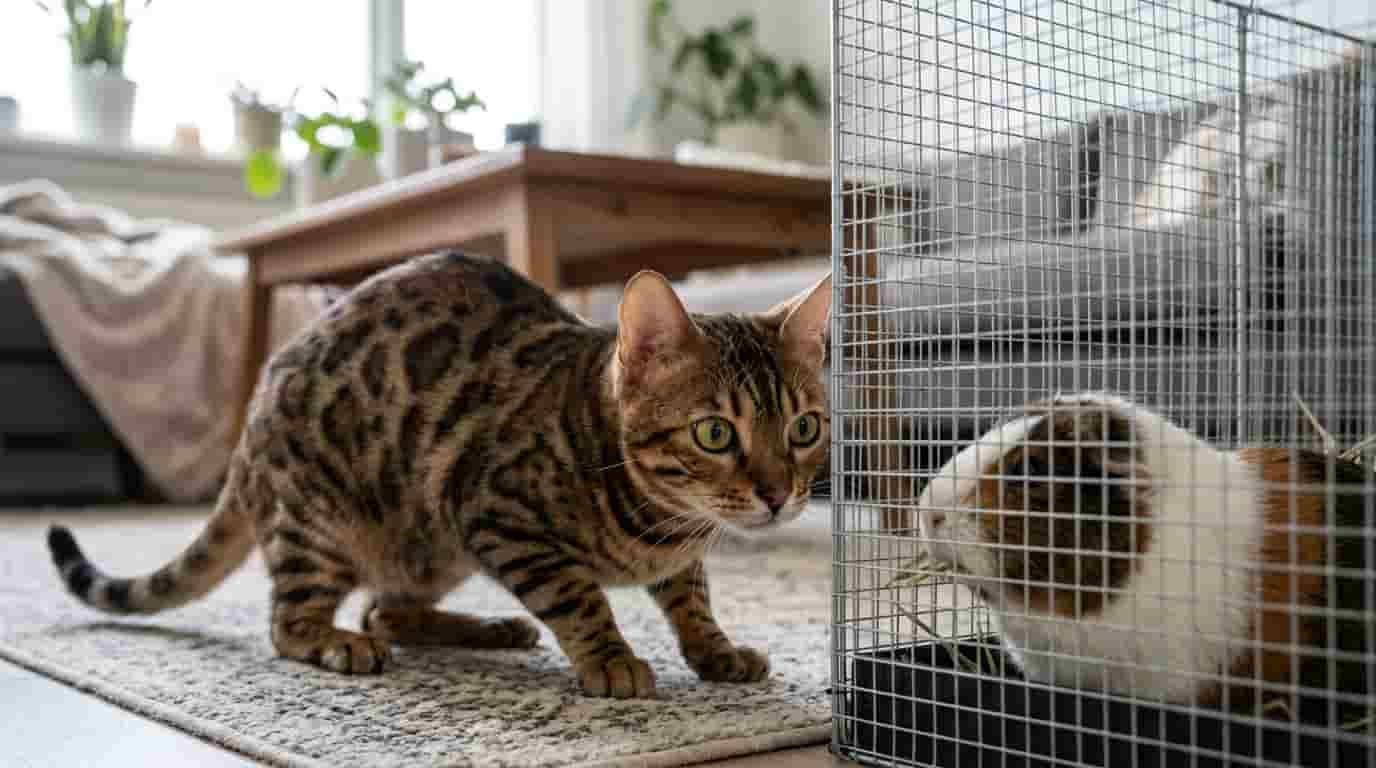
Can Cats Live With Guinea Pigs safely under the same roof? This is one of the most common and vital questions asked by pet owners who are considering bringing a small mammal into a home that already houses a feline companion, or vice versa. To answer it immediately and directly: yes, cats and guinea pigs can potentially live in the same household, but they should never be treated as naturally compatible companion animals or allowed to interact freely without rigorous protection. The central issue is clear and unyielding: a cat’s strong predatory instincts combined with a guinea pig’s fragile anatomy, small size, and status as a prey animal make unsupervised or direct contact extremely dangerous.
A guinea pig can live a healthy, stress-free life in a home with a cat, but success depends entirely on core management principles: strict physical separation, secure housing, diligent supervision, and comprehensive environmental control. Living in the same house is fundamentally different from living together as companions. Understanding how cats perceive small prey animals, recognizing the real risks involved, establishing a cat-proof habitat, and following rigid safety protocols during handling will allow you to protect your guinea pig while maintaining a harmonious multi-pet household.
Can Cats Live With Guinea Pigs Safely?
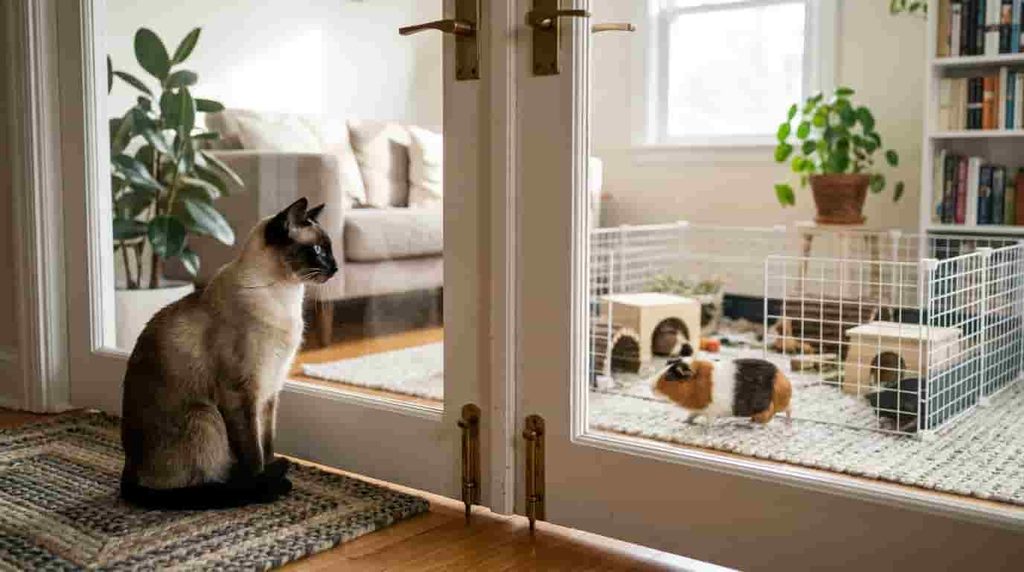
Can guinea pigs live with cats in the same house?
Yes, cats and guinea pigs can occupy the same home, provided the guinea pig is provided with a secure, protected environment at all times. Coexisting under one roof simply means sharing airspace and living within the same walls, whereas interacting directly means allowing the animals to approach, touch, or investigate one another. A guinea pig does not need direct contact with a cat to thrive; in fact, a guinea pig’s well-being depends entirely on never having to face a predator face-to-face. The safest objective for any multi-pet owner is peaceful household coexistence, never direct friendship or shared free-roaming time.
Are cats dangerous to guinea pigs?
Cats are domesticated pets, but they retain powerful, hardwired predatory instincts inherited from their wild ancestors. Small, fast-moving animals with high-pitched vocalizations naturally trigger a cat’s internal hunting sequence, which includes stalking, chasing, pouncing, and batting. Even a normally gentle, affectionate house cat may react with lightning speed if a guinea pig scurries unexpectedly across its field of vision. Assuming that a sweet-natured cat will automatically ignore a small rodent is a dangerous gamble that ignores fundamental feline biology.
Are cats okay with guinea pigs?
Evaluating whether cats are “okay” with guinea pigs requires looking past a cat’s outward personality. A calm cat that sleeps peacefully on the couch all day can still become intensely fixated or aroused when a guinea pig moves around in a nearby enclosure. Because guinea pigs are physically vulnerable and cannot defend themselves against a feline predator, owners must establish reliable physical barriers rather than relying on trust, personality assumptions, or hope. Cats and guinea pigs can potentially share a home, but they must have clearly managed boundaries and should never be left together unsupervised.
Understanding Cat Behavior With Guinea Pigs

Why might a cat chase a guinea pig?
When a cat exhibits interest in a guinea pig, it is usually driven by natural stimuli:
- Movement: Sudden darting or scurrying motions across the floor or inside a cage.
- Small size: Compact proportions that signal potential prey to a hunting feline.
- Sudden sounds: High-pitched squeaks, rustling bedding, or scratching noises.
- Curiosity: Novelty and unfamiliar scents that stimulate investigative instincts.
- Hunting instincts: Hardwired predatory drives that activate automatically upon seeing small animals.
It is critical for owners to understand that chasing does not necessarily mean the cat is angry, malicious, or aggressive; it is often a pure, instinctual response to a moving stimulus.
Why can playful behavior still be dangerous?
Many owners make the mistake of assuming that if a cat is “just playing,” the situation is harmless. However, feline play behavior mimics hunting behavior. Consider the mechanics of cat play:
- Swatting: Sharp claws can easily pierce delicate skin or cause eye trauma.
- Pouncing: The impact of a cat’s body weight can crush or severely injure a small animal’s internal organs.
- Biting: Even a playful nip can cause deep, infected puncture wounds.
- Carrying or grabbing: Dragging or lifting a guinea pig by the body results in catastrophic trauma.
The fundamental rule of multi-pet safety is that intent does not determine risk. A cat playing with a guinea pig can inflict the exact same fatal injuries as a cat hunting one.
What does a cat’s body language tell you?
Learning to read feline body language allows owners to intervene before a dangerous situation escalates. Warning behaviors include:
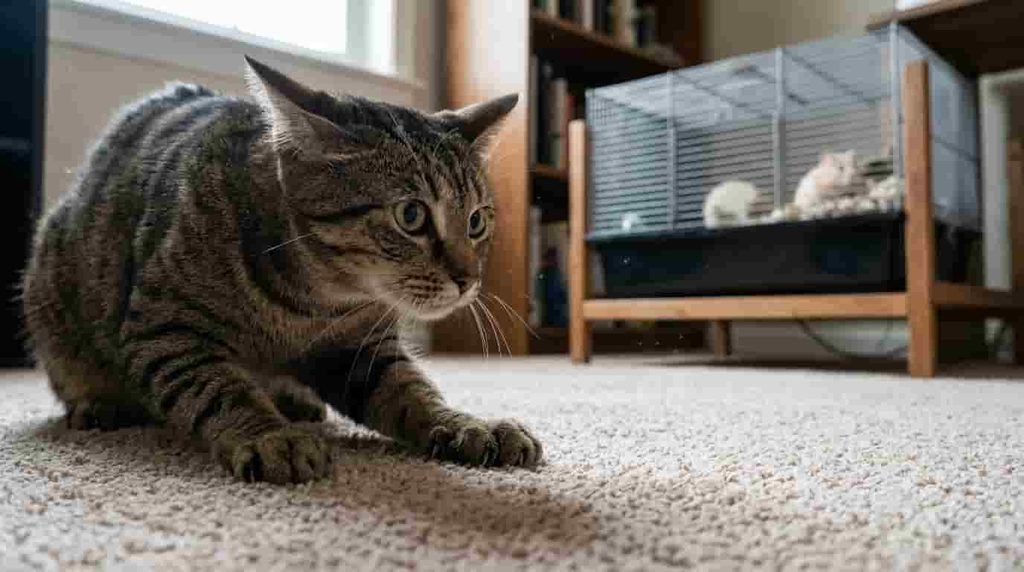
- Fixed staring: Locking eyes on the enclosure without blinking or looking away.
- Crouching: Lowering the body close to the ground to prepare for a spring.
- Stalking: Creeping forward slowly with a tense, rigid posture.
- Tail movement: Twitching, swishing, or low-slung tail tips indicating heightened arousal.
- Pawing: Reaching out with front paws to touch bars, glass, or gaps.
- Pouncing: Launching forward suddenly toward the habitat.
- Repeated access attempts: Constantly returning to the enclosure despite verbal corrections.
When you observe these fixation behaviors, practical guidance dictates that you should respond by increasing distance and strengthening physical barriers rather than encouraging or testing the interaction. Similar behavioral dynamics and predatory considerations must be evaluated when introducing other small species to a cat-filled home, as further outlined in Can Cats Live With Birds? Safety Risks, Introductions and Keeping Them Safe
Why Guinea Pigs May Be Stressed Around Cats
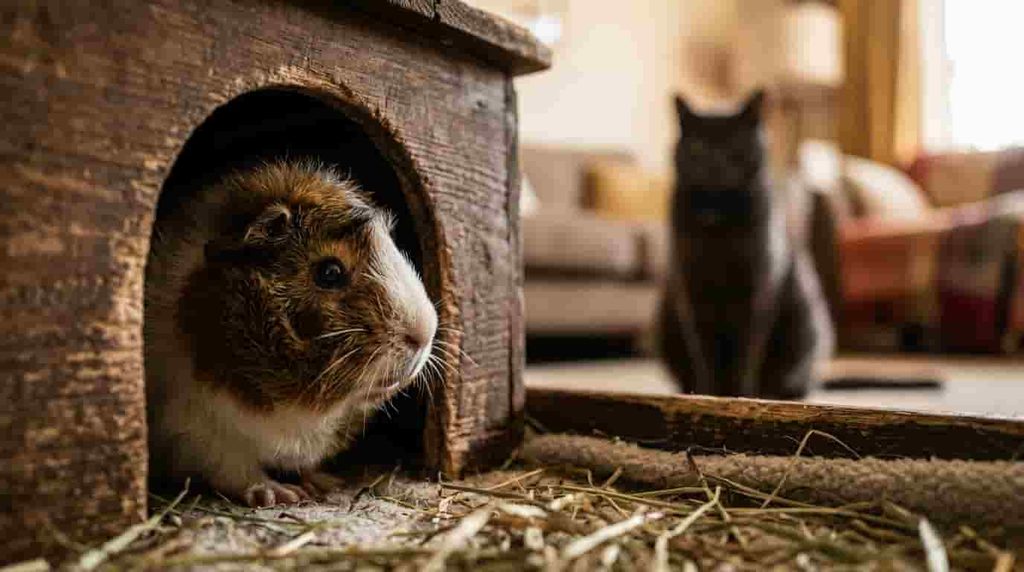
Guinea pigs are vulnerable prey animals
Guinea pigs are small, gentle herbivores whose evolutionary survival depends on hiding, fleeing, and staying hyper-vigilant against predators. A nearby apex predator like a cat represents a constant, terrifying threat. A guinea pig does not need to be physically attacked, scratched, or bitten for the situation to become profoundly stressful; simply knowing a predator is near triggers chronic anxiety.
Signs your guinea pig may be uncomfortable
Determining whether a guinea pig is experiencing stress requires watching for distinct behavioral shifts:
- Hiding excessively: Remaining huddled inside houses or tunnels for abnormal lengths of time.
- Becoming unusually fearful: Freezing in place, trembling, or emitting alarm vocalizations.
- Avoiding normal activity: Pausing foraging, exploring, or wheel-running behaviors.
- Becoming easily startled: Reacting violently to minor household sounds or shadows.
- Changes in normal eating or behavior: Decreased appetite, digestive upset, or lethargy.
Owners should avoid diagnosing stress based on one isolated incident, but consistent behavioral changes warrant an immediate review of the environment.
Why constant exposure is not ideal
Leaving a guinea pig’s cage in an area where the cat can constantly stare, pace, or paw at the enclosure creates unyielding psychological torment. Guinea pigs require a secure retreat where they feel completely hidden and safe from predatory eyes. Reducing visual and physical contact is essential for maintaining their long-term health and emotional well-being.
Main Risks of Keeping Cats and Guinea Pigs Together
Scratches and bites
Even a brief, accidental encounter through cage wire can result in severe physical injury. Feline claws and teeth carry bacteria that can quickly cause deep tissue damage and aggressive localized infections in small mammals. Wounds may be obscured by thick fur and may not always be immediately obvious following an incident.
Chasing and physical trauma
If a guinea pig manages to escape its enclosure while a cat is loose, a high-speed chase will almost certainly ensue. The ensuing panic can cause stress-induced shock, broken bones, cardiac arrest, or severe physical trauma, even if the cat never actually makes direct contact.
Predatory attacks
Stalking, pouncing, grabbing, and biting happen in fractions of a second. Feline reflexes are far quicker than human reaction times, meaning an owner standing nearby may be completely unable to intervene before a tragedy occurs.
Escape-related dangers
A determined guinea pig that chews through plastic or nudges a weak lid open suddenly finds itself exposed in an open room. A frightened rodent running across open floor space acts as an irresistible trigger for a cat’s predatory drive.
Stress from repeated access attempts
A cat that is allowed to jump on top of the cage, paw at the walls, or stare unblinkingly into the enclosure creates a hostile environment. This chronic stress suppresses the guinea pig’s immune system and degrades its quality of life.
Disease and parasite concerns
Pet owners frequently ask: “Can cats give guinea pigs diseases?” While direct transmission of common feline-specific viruses to guinea pigs is relatively uncommon, sharing a household creates shared environmental hygiene considerations. For example, external parasites like fleas can occasionally jump between hosts, and shared surfaces can accumulate pathogens. You should always discuss unusual health or parasite concerns with a veterinarian familiar with exotic pets and guinea pigs rather than relying on home remedies.
How to Cat-Proof a Guinea Pig Habitat
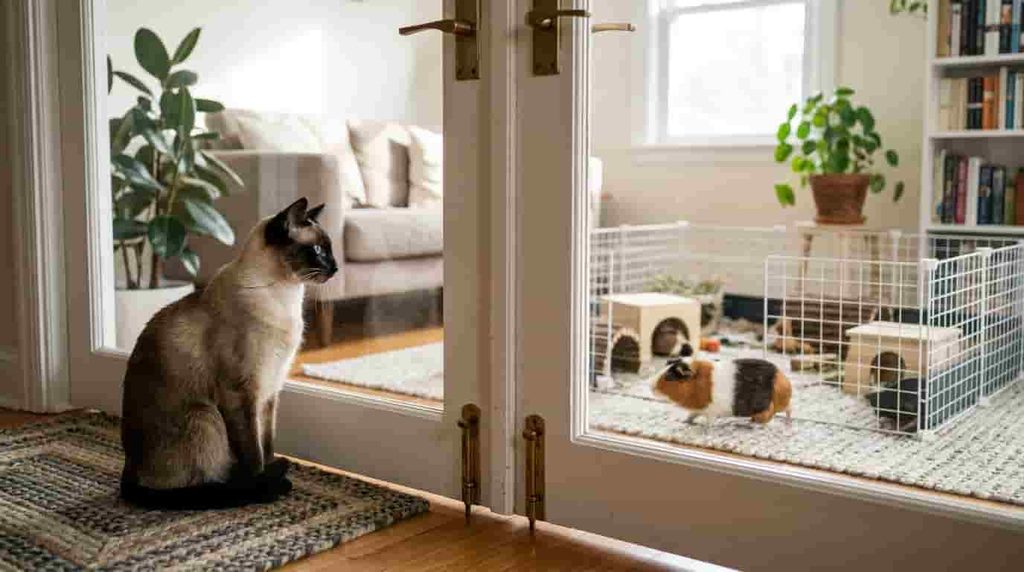
Choose a secure enclosure
The cornerstone of a safe multi-pet home is an unyielding, escape-proof and cat-proof enclosure:
- Strong construction: Utilize heavy-duty C&C grids with reinforced zip ties, sturdy wooden hutches, or thick glass enclosures with heavy, lockable metal mesh lids.
- Secure openings: Ensure all doors, latches, and lids require adult dexterity to open and cannot be nudged, shoved, or pawed loose by a heavy cat.
- Reliable latches: Use spring clips or secondary locks on all access doors.
- Adequate ventilation: Maintain excellent airflow while ensuring wire spacing is narrow enough that a cat’s claws or paws cannot slip through the gaps.
Place the enclosure in a safe location
Where you put the habitat matters just as much as its build quality:
- Position the enclosure on a heavy, stable piece of furniture that cannot be tipped over or shaken by a leaping cat.
- Keep the habitat well away from surfaces that a cat can easily jump onto, such as tall dressers, bookshelves, or countertops.
- Ensure the cat cannot sit directly on top of the mesh roof or press its body weight against the enclosure walls.
Prevent access from above and around the sides
Cats are exceptional vertical jumpers and climbers. Do not assume an open-topped table cage is safe simply because it is off the floor if a cat can leap down onto it from a nearby shelf. Evaluate every angle of approach from a feline perspective to eliminate potential weak points.
Create hiding spaces inside the guinea pig habitat
Guinea pigs need multiple dark, enclosed hiding spots (such as wooden tunnels, bridges, and houses) where they can completely shield themselves from view. These retreats give the guinea pig a psychological safe haven even if a cat wanders into the room.
Inspect the setup regularly
Perform routine safety audits using a simple checklist:
- Are all latches and locks fully engaged and functional?
- Can the cat reach its paws or claws through any part of the wire mesh?
- Is the enclosure structure completely stable and wobble-free?
- Has the cat attempted to chew, claw, or damage any component of the habitat?
- Is there any possibility the guinea pig could push its way out?
Introducing Cats to Guinea Pigs Safely
Start with complete physical separation
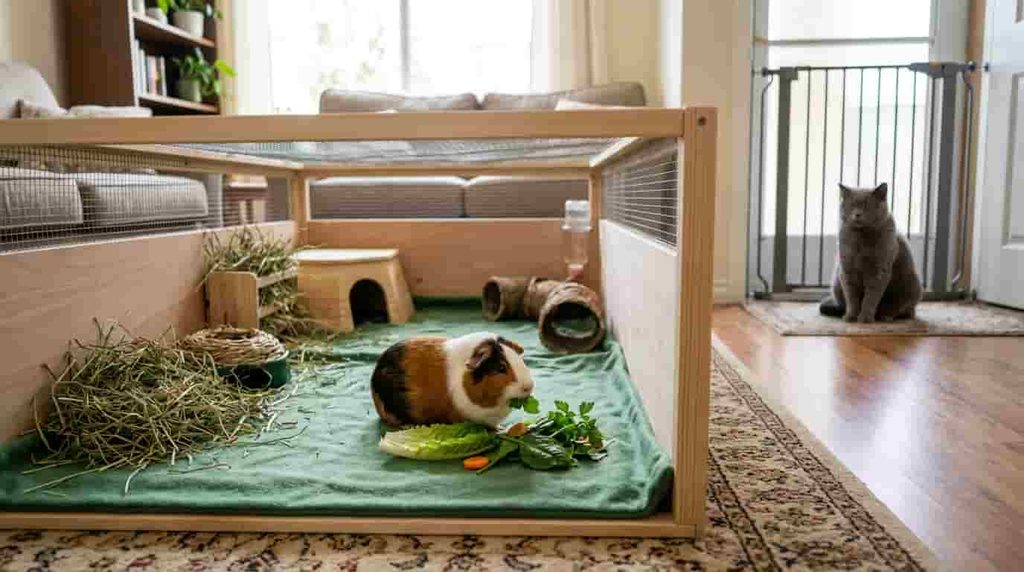
When bringing a new guinea pig into a cat-dominated home (or vice versa), begin with absolute isolation. Keep the guinea pig securely housed in a dedicated room with the door firmly shut for the first several days. Let the cat adjust to the ambient scent drifting under the door before any visual introduction takes place.
Watch the cat’s reaction
When you eventually allow the cat to observe the securely housed guinea pig from a safe distance, monitor its body language carefully:
- Calm observation or indifference.
- Excessive fixation, staring, or pacing.
- Crouching and stalking postures.
- Pawing or batting at the enclosure bars.
- Agitation, vocalization, or frantic attempts to reach the animal.
Calm, relaxed behavior is a positive sign, but it does not mean the cat can ever be trusted without physical barriers.
Reward calm behavior
Use positive reinforcement, praise, and treats when the cat acknowledges the habitat calmly and then walks away. Avoid harsh physical punishments if the cat becomes overly excited, as punishment creates negative associations and increases predatory frustration.
Never use direct contact as a “test”
Strong Warning: Never place a guinea pig next to a cat to “see how they react.” Never place a guinea pig directly on the floor with a cat, and never allow a cat to paw at an unprotected animal. Such reckless tests frequently end in catastrophic injury or death in a fraction of a second.
Increase separation if necessary
If the cat remains permanently fixated, obsessed, or agitated around the guinea pig habitat, you must increase physical separation. Keep the pets in completely separate rooms with closed doors 24/7. Safety and peace of mind must always take priority over creating a relationship between two naturally incompatible species.
Should Cats and Guinea Pigs Ever Interact Directly?
Is supervised interaction safe?
Many owners believe that active human supervision makes direct interaction safe. In reality, human reaction times are simply too slow to prevent a lightning-fast feline pounce. A cat can cross a room and strike in milliseconds, leaving a human standing too far away to block the attack. Furthermore, a guinea pig cannot defend itself effectively against a cat.
Can guinea pigs be around cats?
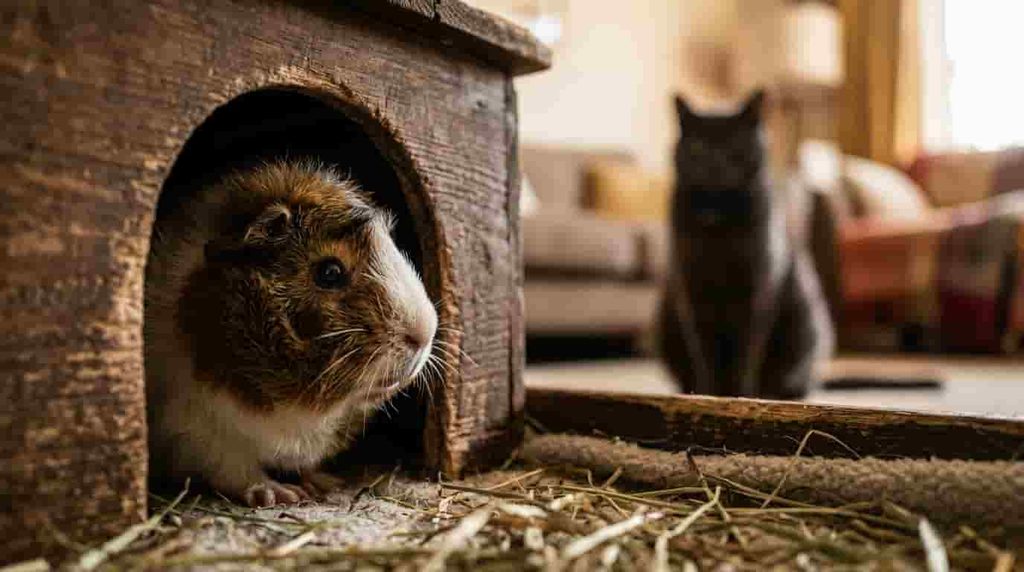
To answer the PAA directly: they may inhabit the same general household environment, but direct proximity should be strictly and carefully controlled. The guinea pig must remain protected inside a secure, cat-proof enclosure at all times when the cat is roaming free in the home.
Is friendship necessary?
No. Guinea pigs do not need a cat as a companion. Their social and environmental needs must be met appropriately within their own species—ideally by living in bonded pairs or small groups of fellow guinea pigs—alongside proper cage setups and human enrichment. Safe distance is vastly more valuable than forced, unnatural interspecies interaction.
Safe Out-of-Cage Time for Guinea Pigs
Keep the cat out of the room
Before you open the guinea pig’s habitat to clean, feed, or take your pet out for floor time, ensure the cat is securely locked out of the room. Close the door firmly, check that the cat isn’t slipping through the doorway behind your legs, and lock the latch.
Check the room first
Before letting your guinea pig roam in a designated exercise area, inspect the space thoroughly for:
- Open doors or unlatched entryways.
- Gaps behind furniture where the guinea pig could become trapped.
- Unsafe electrical cords or toxic house plants.
- Other pets that might roam into the area.
Return the guinea pig before giving the cat access
Always return the guinea pig securely to its locked enclosure and double-check all latches before unlocking the room door to let the cat back in. Never hold your guinea pig in your hands while opening the door to a curious feline.
Why this routine matters
Establishing a strict, predictable safety routine removes the need to react during a sudden, chaotic encounter. It builds an infallible safety system that protects your pets even when you are tired or distracted. Similar safety protocols are vital when managing other multi-pet dynamics, such as those discussed in Can Cats Live With Rabbits? Safety, Introductions and How to Keep Them Together
Warning Signs That Your Cat Should Be Kept Further Away
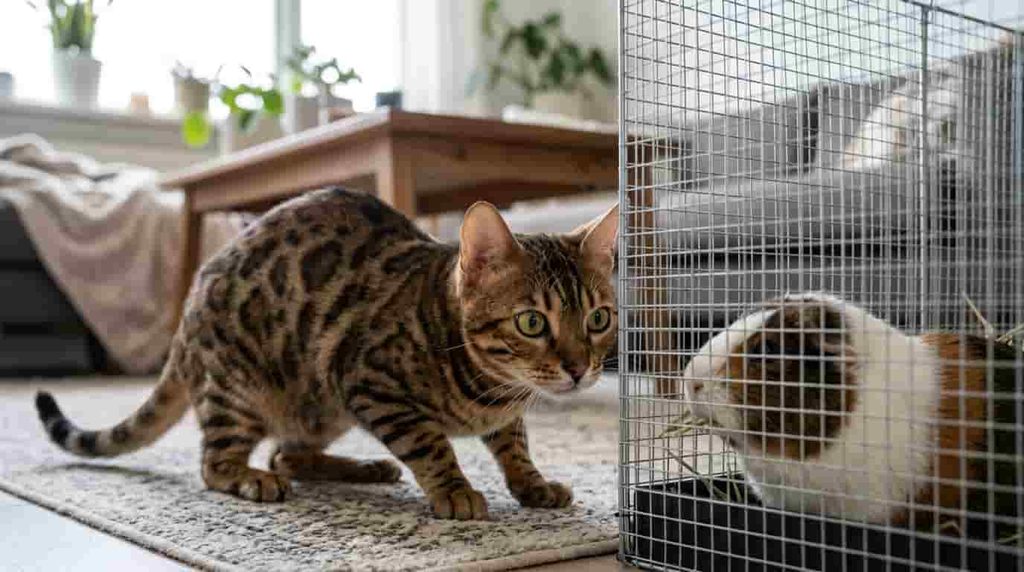
Cat warning signs
If your cat exhibits any of the following behaviors, you must immediately increase distance and strengthen your barriers:
- Persistent, unblinking staring at the guinea pig enclosure.
- Crouching low to the floor in a stalking posture near the cage.
- Pawing, scratching, or batting aggressively at wire mesh or glass.
- Waiting stealthily beside the habitat table for extended periods.
- Pouncing violently whenever the guinea pig moves or rustles bedding.
- Trying to force open doors, chew plastic, or dismantle habitat panels.
- Displaying high arousal and refusing to respond to verbal redirection or toy distraction.
Guinea pig warning signs
Watch your guinea pig for indicators of chronic fear or discomfort:
- Increasing the amount of time spent hiding in tunnels and houses.
- Repeated startling, freezing, or trembling.
- Unusual fearfulness or panic when humans approach.
- Disruption of normal eating, drinking, or social routines.
- Reluctance to use open areas of the cage where the cat is visible.
If either animal appears stressed or fixated, increase separation immediately rather than attempting to force them to adapt to one another.
Common Mistakes When Keeping Cats and Guinea Pigs Together
- Mistake 1: Assuming a friendly cat cannot hurt a guinea pig. Temperament and cuddliness do not erase millions of years of feline predatory instinct.
- Mistake 2: Allowing one “quick” interaction. A brief, unsupervised meeting can still turn deadly in a split second.
- Mistake 3: Leaving the enclosure unsecured. A cage that keeps the guinea pig inside may still feature wide wire spacing that allows a cat’s claws to reach inside.
- Mistake 4: Putting the habitat where the cat can climb. Elevating cages onto unstable surfaces or placing them near tall furniture invites feline jumps.
- Mistake 5: Allowing the cat to paw at the enclosure. Letting cats “play” with the cage teaches them that the guinea pig is a toy, escalating stress and structural risk.
- Mistake 6: Taking the guinea pig out while the cat is loose. Opening a cage door in the same room where a cat is roaming is an open invitation for tragedy.
- Mistake 7: Treating curiosity as friendship. Confusing predatory interest or hunting curiosity with social affection is a fatal anthropomorphic error.
Managing Cats and Guinea Pigs in a Multi-Pet Household
Create permanent boundaries
Establish clear, non-negotiable spatial rules in your home. Designate specific rooms where the cat has full run, and establish secure, quiet sanctuaries where the guinea pig’s habitat sits undisturbed behind locked doors.
Make the safe choice easy
Rely on physical architecture—solid doors, reliable latches, and heavy furniture—rather than constant human vigilance or willpower. Good architecture prevents accidents when humans are tired or distracted.
Provide enrichment for the cat
Give your cat appropriate outlets for play and exploration, such as interactive wand toys, food puzzles, climbing trees, and hunting games. A well-exercised, content cat is far less likely to obsess over a hidden small animal. When integrating multiple small prey species alongside felines, understanding general habitat safety principles—such as those detailed in Can Cats Live With Hamsters? Safety Risks, Introductions and Keeping Them Safe —helps maintain a secure home environment.
Monitor changes over time
A cat’s behavior, energy levels, or curiosity can change as pets age. A habitat setup that worked perfectly initially should still be audited regularly to ensure structural integrity remains uncompromised.
Can Cats and Guinea Pigs Coexist if the Cat Has a Strong Hunting Instinct?
A strong prey drive significantly increases the management challenge in a multi-pet household. If your cat has a proven history of catching mice, birds, or other small animals outdoors, its predatory motivation will be exceptionally high. Persistent stalking, frantic pacing, or obsessive fixation should be taken very seriously. In homes with high-drive hunters, owners may require permanent, absolute physical separation—such as keeping the guinea pig in a dedicated sanctuary room where the cat is never permitted to enter. If your home layout cannot support reliable, permanent separation, keeping both animals safely under one roof may prove unmanageable.
Decision Checklist:
- Can the guinea pig be housed in a genuinely secure, cat-proof habitat?
- Can the cat be locked out of the room completely during handling and floor time?
- Can doors, barriers, and latches be maintained consistently every single day?
- Can everyone in your household follow the exact same safety rules?
- Is there a reliable backup plan if the cat’s fixation intensifies over time?
What If A Cat Attacks or Injures A Guinea Pig?
Separate the animals immediately
If an encounter occurs, separate the animals immediately without risking a bite to yourself. Handle the injured guinea pig with extreme care, wrapping it gently in a soft towel to reduce shock and panic.
Do not assume a small wound is harmless
Injuries from another animal—even minor-looking scratches or tiny puncture marks—can rapidly develop into severe, life-threatening abscesses or systemic infections due to bacteria in feline saliva. Avoid relying on home-treatment instructions or DIY remedies.
When to contact a veterinarian
Seek prompt, professional veterinary advice immediately after:
- A bite, puncture, or deep scratch from a cat.
- A fall, drop, or traumatic structural collapse involving the enclosure.
- Any visible bleeding, limping, open wounds, or swelling.
- Sudden weakness, lethargy, shock, or refusal to eat.
Always seek out a veterinarian experienced with exotic pets, small mammals, and guinea pigs, as their specialized anatomy requires expert medical care.
Can Guinea Pigs Live With Cats and Dogs?

Guinea pigs are exceptionally vulnerable to predatory interest from multiple household companion animals, including both cats and dogs. The underlying safety principles remain identical: secure, heavy housing, absolute physical separation, locked doors, and never allowing direct, unsupervised contact between the prey animal and larger household pets.
Briefly Addressing Other PAA/PASF Questions
Can cat fleas live on guinea pigs?
External parasites can occasionally jump between household hosts if an infestation occurs. Maintaining rigorous flea prevention for your cat is an important layer of multi-pet health management. If you suspect any parasite transfer, consult a veterinarian for safe, species-appropriate treatments rather than applying cat-specific medications to a guinea pig.
What pets do guinea pigs get along with?
Guinea pigs have distinct social needs and generally get along best with their own kind. They are herd animals and thrive when housed in bonded pairs or groups with other guinea pigs. They do not require dogs or cats for companionship.
Do house cats attack guinea pigs?
Yes, house cats may attack or injure guinea pigs. Owners should never rely on a cat being “domesticated,” well-fed, or familiar with humans to override its natural predatory instincts when presented with a small, fast-moving rodent.
Frequently Asked Questions
FAQ 1: Can cats live with guinea pigs?
Yes, they can share the same household, but they must be kept strictly and permanently separated by secure housing and closed doors to ensure the guinea pig’s safety.
FAQ 2: Are cats dangerous to guinea pigs?
Cats possess strong predatory instincts and hunting reflexes, making even a friendly cat potentially dangerous to a fragile guinea pig due to the extreme size and vulnerability difference.
FAQ 3: Can guinea pigs be around cats?
They may inhabit the same home environment, but direct proximity should be strictly controlled, with the guinea pig remaining protected inside a secure enclosure.
FAQ 4: Can cats give guinea pigs diseases?
While direct transmission of feline-specific viruses is rare, shared spaces can create health and hygiene considerations; veterinary guidance should always be sought if parasite or illness exposure is suspected.
FAQ 5: Can I get a cat if I already have guinea pigs?
Yes, provided your household can consistently maintain secure, unyielding physical separation and provide a dedicated, cat-free sanctuary space for your guinea pigs.
Conclusion: Can Cats Live With Guinea Pigs?
To summarize the core question: Can Cats Live With Guinea Pigs in the same home? Sharing a household can certainly be possible with proper planning, but direct interaction is entirely unnecessary and carries avoidable, high-stakes risk. Secure housing is essential, supervision is useful but should never replace physical barriers, and out-of-cage guinea pig playtime must happen without the cat present in the room. Cat behavior should be monitored continuously for signs of obsession or hunting fixation.
Frame responsible coexistence around protecting the more vulnerable animal rather than trying to create an impossible interspecies friendship. By designing your home environment around absolute safety, you protect your guinea pig from harm while allowing both pets to live peaceful, stress-free lives.
How do you manage physical boundaries and multi-pet routines in your household? Share your experiences and tips in the comments below!