
Cat Scent Marking: Why Your Pet Rubs Their Face on Your Legs
Introduction:
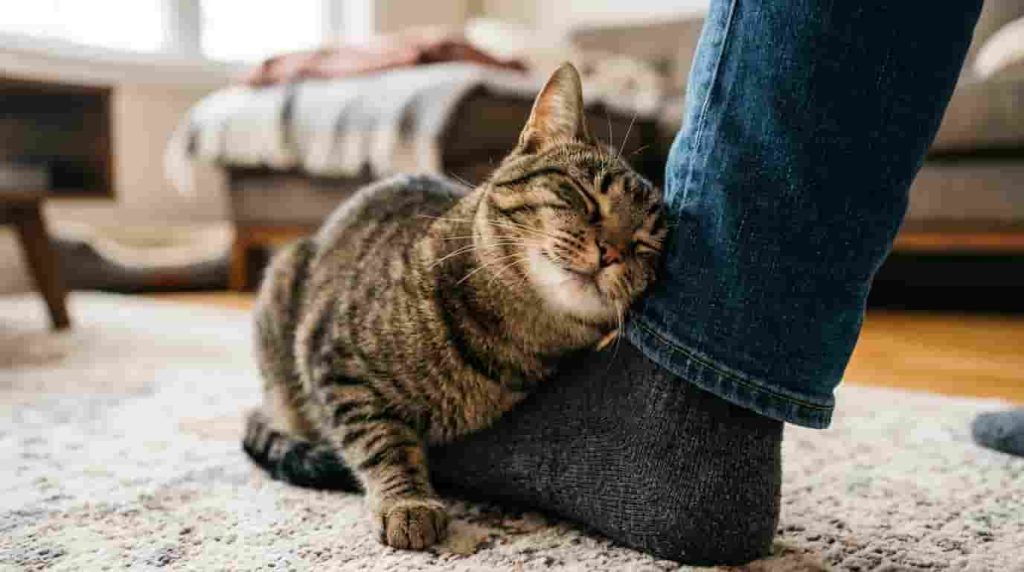
Cat scent marking is something your cat does dozens of times every single day, and most owners have absolutely no idea it is even happening. Your cat brushes their cheek against your ankle as you walk through the door. They press their forehead against the corner of your sofa. They dig their paws into their favourite blanket before settling down for a nap.
Every one of these actions carries a specific chemical message that only other cats can fully read. Your cat is not being randomly affectionate or quirky. They are actively managing their world through an invisible but incredibly detailed scent landscape they build and maintain constantly.
Understanding cat scent marking changes how you interpret your cat’s everyday behaviour entirely. Furthermore, it helps you respond more appropriately when marking goes from adorable face-rubbing to unwanted spraying on your furniture or walls. The difference between these two behaviours makes complete sense once you understand the communication system driving them both.
This guide covers all the ways cats use scent to communicate, which body parts they use and why, what different marking behaviours actually mean, and how to handle the situations where marking becomes a problem worth addressing.
Cat Scent Marking: The Invisible Language Your Cat Speaks Every Day
Cats live in a world shaped primarily by smell rather than sight or sound. Their sense of smell is roughly fourteen times more powerful than a human’s. As a result, scent carries the kind of detailed social information that humans exchange through words and facial expressions.
Cat scent marking uses specialised glands located across multiple areas of the body. Each gland releases pheromones, which are chemical signals that trigger specific responses in other cats who encounter them. These chemical messages persist long after your cat has moved away from the spot, creating a communication system that works across time and space simultaneously.
The main scent gland locations on a cat’s body include:
- Cheeks and chin which your cat uses during face-rubbing against people, objects, and other animals
- Forehead which deposits scent during the characteristic head-bump cats give their favourite humans
- Paw pads which leave scent through scratching and kneading behaviours
- Flanks and tail base which transfer scent during body-rubbing against surfaces and other cats
- Anal glands which release strong individual identifying scent information
According to VCA Animal Hospitals, cats use scent marking primarily to establish territorial boundaries, communicate reproductive status, and reduce social anxiety by creating familiar-smelling environments. Understanding this helps explain why a cat marks more intensely in situations that feel uncertain or threatening to them.
What Face Rubbing and Head Bumping Really Mean
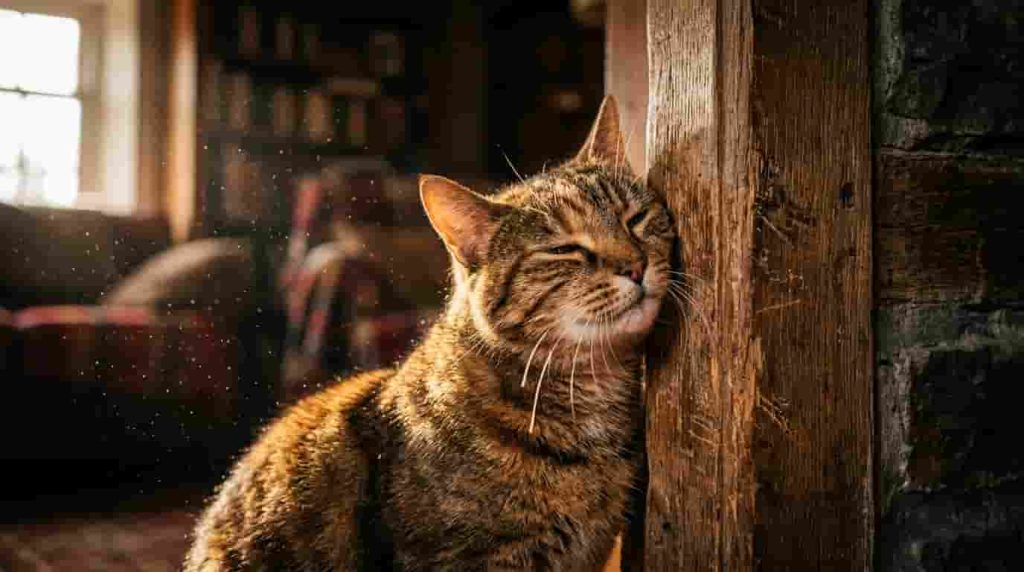
When your cat rubs their face against your legs the moment you walk through the front door, they are doing something remarkably intentional. This behaviour is called bunting, and it represents one of the most positive forms of feline scent communication that exists.
Bunting deposits scent from the cheek and forehead glands onto a person or object. Your cat essentially applies their personal scent signature to something they consider safe, valued, and part of their inner social circle. Therefore, being bunted by your cat is genuinely one of the highest compliments they offer.
This same behaviour serves an important comfort function as well. When your cat rubs against furniture, doorways, and walls throughout your home, they create a continuous familiar scent map that makes their environment feel settled and secure. A home that smells like them feels safe to a cat in a deeply biological way.
New cats brought into a home often increase this type of marking dramatically as they try to establish familiarity in an unfamiliar space. If you are navigating this situation, reading about cat jealousy signs gives you a fuller picture of how resident cats communicate territorial stress during introductions and what you can do to ease the transition for everyone involved.
The Role of Scratching in Feline Scent Communication

Scratching confuses many cat owners because it looks purely destructive on the surface. However, scratching is one of the most layered and information-rich forms of cat scent marking that your cat uses regularly.
When your cat scratches a surface, two things happen simultaneously. First, the physical scratch marks create a visible signal that other cats can see. Second, the paw pads deposit pheromone-rich scent onto the scratched surface at the same time. The combination creates a marking post that communicates your cat’s presence, size, and confidence to any cat that passes by.
This is precisely why cats scratch the same spots repeatedly rather than moving around to new locations. Refreshing an existing scratch mark reinforces and updates the chemical message rather than simply adding another random mark to the environment.
Cats choose scratching locations very deliberately. They favour:
- Prominent vertical surfaces near entrances and exits to rooms
- Spots close to where they sleep to mark their personal resting territory
- Shared social spaces where multiple household members spend regular time
- Areas near windows and doors where outdoor cat scent occasionally drifts inside
Providing appropriate scratching posts in these preferred locations protects your furniture while still allowing your cat to fulfil this important behavioural need. Tall, stable posts positioned near doorways and sleeping areas work far better than posts placed in ignored corners of a room.
Understanding Urine Marking and Cat Spraying Behaviour
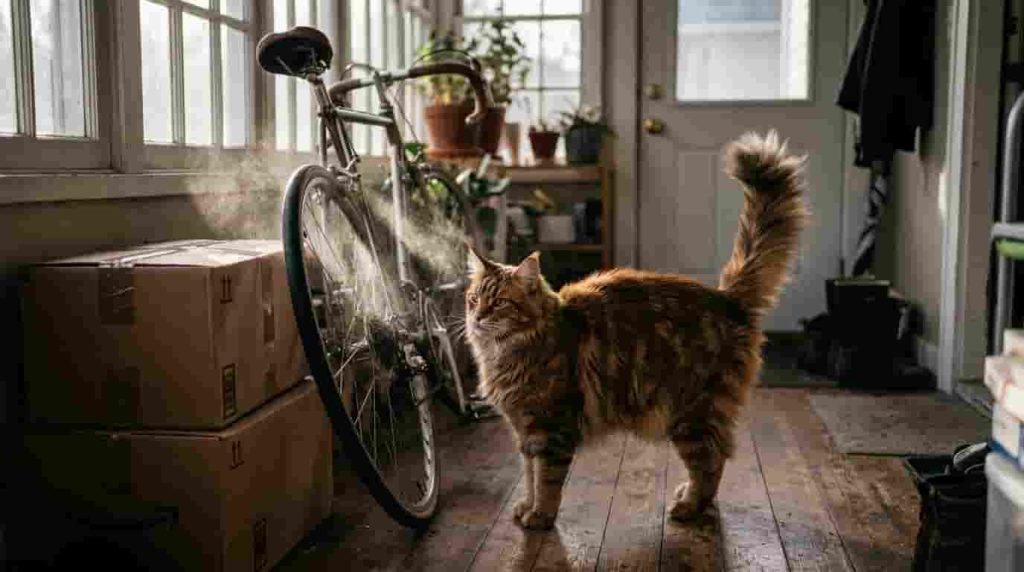
Urine marking represents a completely different category of cat scent marking from the gentle bunting and scratching behaviours covered so far. This form of marking causes the most friction between cats and their owners and deserves a thorough explanation on its own.
Urine marking in cats involves depositing small amounts of urine on vertical surfaces such as walls, furniture legs, and door frames. The cat backs up to the surface, holds their tail upright and quivering, and sprays a fine mist of urine directly onto the target. This behaviour differs clearly from normal toileting in a litter box and serves a purely communicative purpose rather than an eliminative one.
Both male and female cats engage in urine marking, though unneutered males do so most frequently and with the strongest-smelling output. The chemical information in sprayed urine communicates a cat’s sex, reproductive status, health condition, and individual identity to any cat that encounters it. In multi-cat environments or areas with outdoor cats nearby, this information exchange becomes particularly intense.
Consider what happened to Ngozi in Lagos, Nigeria. Her three-year-old male cat Oga suddenly started spraying the front door and living room curtains after a neighbour’s cat began appearing regularly on their shared compound wall. Oga had never sprayed indoors before this. Once Ngozi understood that Oga was responding to the perceived territorial threat from the outdoor cat, she addressed the problem by blocking Oga’s sightline to the compound wall and using a veterinary-recommended pheromone diffuser indoors. The spraying stopped within two weeks.
Why Stress Triggers Increased Territorial Marking

Stress and anxiety represent the most common underlying causes of sudden increases in territorial marking behaviour. When a cat feels uncertain, threatened, or insecure, their instinct drives them to increase their chemical presence in the environment to reassert familiarity and control.
Common stress triggers that cause cats to mark more intensely include:
- New people, animals, or babies entering the home and disrupting established routines
- Moving to a new home where no familiar scent exists anywhere in the environment
- Changes to daily routine including feeding schedule shifts or owner absences
- Outdoor cats visible through windows creating perceived territorial pressure
- Multi-cat tension when household cats compete for resources or preferred resting spots
- Owner stress or emotional changes which cats detect and respond to surprisingly accurately
Separation anxiety produces particularly intense marking responses in some cats who mark heavily near doors and personal belongings when their owners are away for extended periods. If you work long hours away from home, reading about cat separation anxiety gives you targeted strategies for reducing the stress that drives this kind of excessive marking in cats left alone during the working day.
Additionally, cats experiencing pain sometimes increase marking behaviour as an anxiety response to physical discomfort. If your cat’s marking increases suddenly without any obvious environmental trigger, a veterinary check to rule out underlying health issues is always the right first step before attempting any behavioural intervention.
How to Manage Problem Marking Without Punishing Your Cat
Punishing a cat for scent marking behaviour never works and always makes the underlying problem significantly worse. Your cat marks because of a genuine biological drive or emotional need. Punishment increases their anxiety, which directly drives further marking in a frustrating and counterproductive cycle.
These practical strategies genuinely reduce problematic marking behaviour:
1. Neuter or spay your cat if you have not already done so. Neutering reduces urine marking behaviour in approximately ninety percent of male cats and significantly in females as well. This single step eliminates the reproductive communication component from spraying and reduces the intensity of territorial marking considerably. The ASPCA recommends neutering as the single most effective intervention for cats that spray.
2. Use synthetic pheromone products strategically. Feliway diffusers and sprays release synthetic versions of the feline facial pheromones your cat produces during bunting. These products create an artificially familiar-smelling environment that reduces the anxiety driving stress-related marking. Place diffusers in rooms where marking occurs most frequently.
3. Clean marked areas with enzymatic cleaners only. Standard household cleaners mask the smell to human noses but leave the chemical marking signal fully intact for your cat. Enzymatic cleaners break down the proteins in urine and scent deposits completely, removing the signal that tells your cat to keep refreshing that spot.
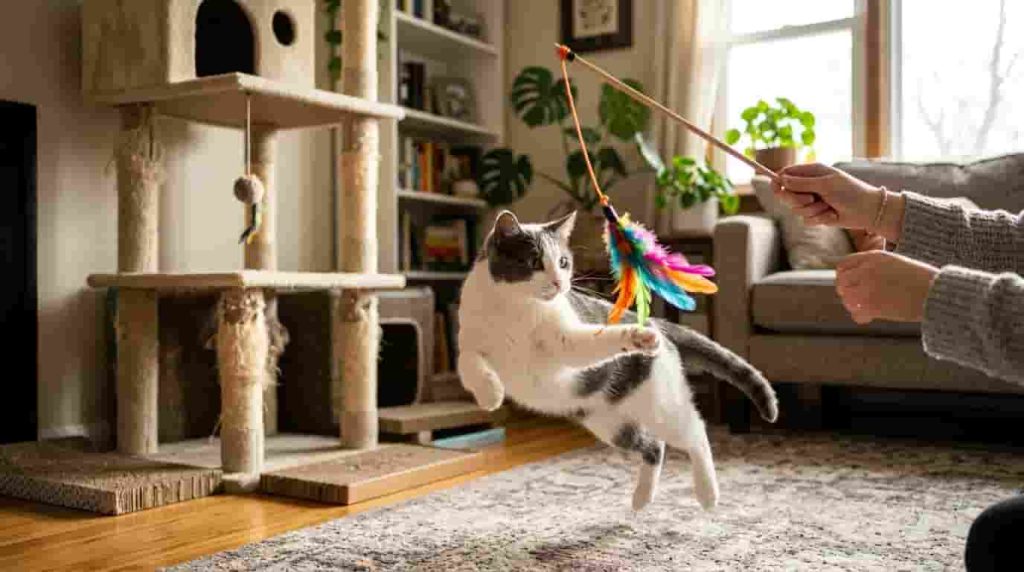
4. Reduce access to stress triggers where possible. Block window views of outdoor cats using frosted film or furniture repositioning. Provide separate resources for each cat in multi-cat households to reduce competition. Maintain consistent feeding and play routines to minimise daily unpredictability.
Cats that bite or act out during stressful marking periods often benefit from redirected play as an outlet for excess tension. The article on cat biting during play covers gentle training techniques that help cats manage emotional arousal without escalating into aggressive behaviour. Similarly, if your cat redirects tension toward hunting small animals indoors, reading about cat hunting geckos addresses safety concerns related to prey contact that often appear in stressed and highly territorial cats.
Conclusion
Cat scent marking is not random behaviour, bad manners, or a sign of a poorly trained cat. It is a sophisticated and biologically driven communication system your cat uses to navigate their social world, manage anxiety, and express affection and ownership simultaneously.
Face rubbing and head bumping tell you that your cat trusts and values you deeply. Scratching in prominent locations communicates territorial confidence. Urine marking signals stress, anxiety, or a perceived threat that your cat needs help addressing.
Understanding cat scent marking transforms your ability to respond to your cat’s real needs rather than simply reacting to the surface behaviour. With the right environment, appropriate outlets, and reduced stress triggers, most marking problems resolve completely over time.
Has your cat ever marked unexpectedly or in a confusing way? Share your story in the comments below and tell us what finally helped you understand or solve the behaviour!
Frequently Asked Questions
Your cat rubs their face on you to deposit scent from their cheek glands and mark you as a safe and trusted member of their social group. This behaviour called bunting is one of the most affectionate things a cat can do and signals deep comfort and attachment. It also refreshes familiar scent on you after your absence has diluted it throughout the day.
Start by having your cat neutered or spayed if this has not been done yet, as this resolves spraying in the majority of cats. Identify and reduce any stress triggers such as visible outdoor cats, changes in routine, or multi-cat tension in the home. Use enzymatic cleaners on marked areas and consider a pheromone diffuser in rooms where spraying occurs most often.
These are two different behaviours with different causes and solutions. Scent marking involves spraying small amounts on vertical surfaces as communication. Inappropriate elimination involves depositing larger amounts on horizontal surfaces and usually signals a litter box problem, health issue, or different type of stress. A vet visit helps identify which behaviour your cat is displaying if you are unsure.
Yes, female cats scent mark using all the same methods as males including face rubbing, scratching, and urine spraying. Unneutered females spray more frequently, particularly during heat cycles when reproductive communication drives intense territorial marking. Spaying greatly reduces urine marking in female cats just as neutering does in males.
Your cat scratches visible furniture in your presence partly to refresh their scent marks and partly to communicate their presence confidently within the shared social space. Providing a tall stable scratching post positioned near the furniture they prefer redirects this need appropriately without removing it entirely. Cats need to scratch and mark as a core behavioural drive, so redirection works far better than attempting to stop it completely.