Cat Mirror Self Awareness: Do they recognize their own reflection.
Introduction:
Cat Mirror Self Awareness is a topic that puzzles many pet parents when they watch their furry friends encounter a looking glass. You might see your kitten hiss, puff its tail, or completely ignore the glass. This leaves owners wondering if their beloved pets truly know who they are looking at.
Understanding this behavior requires a deep dive into animal cognition and sensory perception. Because cats experience the world differently than humans, their reactions to reflections can teach us a lot about cat intelligence.
Furthermore, exploring self-awareness in cats helps us build stronger bonds with our feline companions. This article will break down how cats view reflections and what science says about their mental world.
Cat Mirror Self Awareness Explored
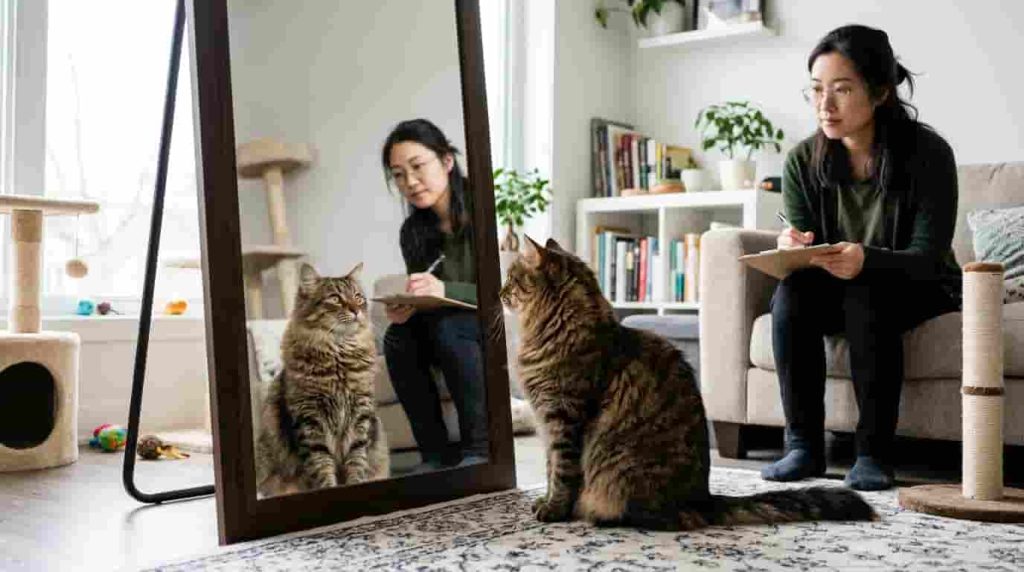
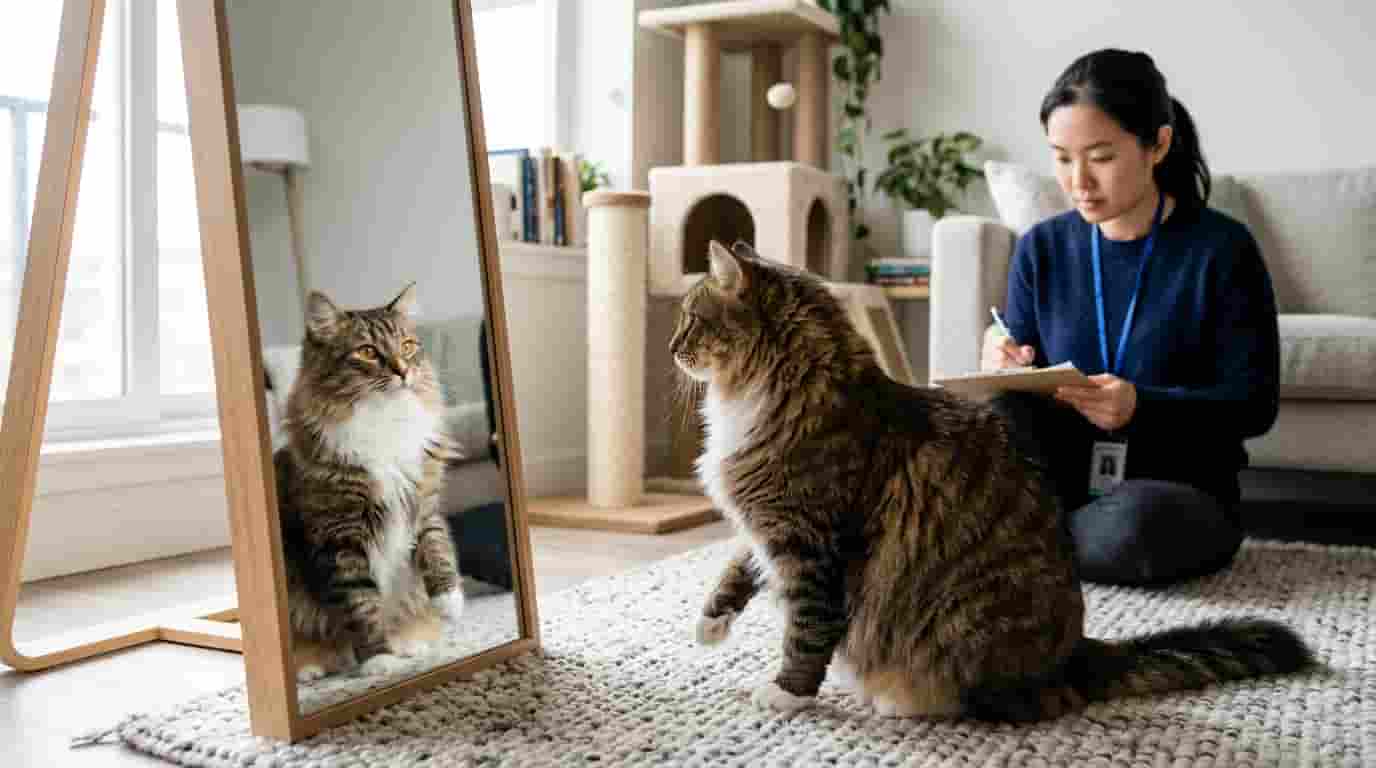
To understand cat mirror self awareness, we must first look at how scientists test for feline self-recognition in laboratories. Researchers use a famous experiment called the mirror test to evaluate self-awareness in pets across various species. During this test, scientists place an odorless mark on the animal’s forehead and then position them before a glass.
If the animal looks into the reflection and touches the mark on its own body, it passes. Chimpanzees, dolphins, and elephants have successfully passed this specific test over the years. However, multiple cat behavior studies show that our feline friends consistently fail to recognize themselves in this manner.
Because they fail the visual test, some people assume that cats lack any form of cat consciousness. That conclusion is actually incorrect because cats simply rely on different senses to perceive reality.
Humans depend heavily on sight, but a cat relies much more on scent and sound to identify objects. Therefore, a lack of visual feline self-recognition does not mean your pet lacks overall intelligence.
Additionally, we must remember that a reflection has no smell and makes no sound. When a cat looks at the glass, the image lacks the vital sensory data they need. Consequently, cat behavior research suggests that cats view the reflection as a strange, ghostly entity rather than themselves.
What Science Says About Feline Self-Recognition
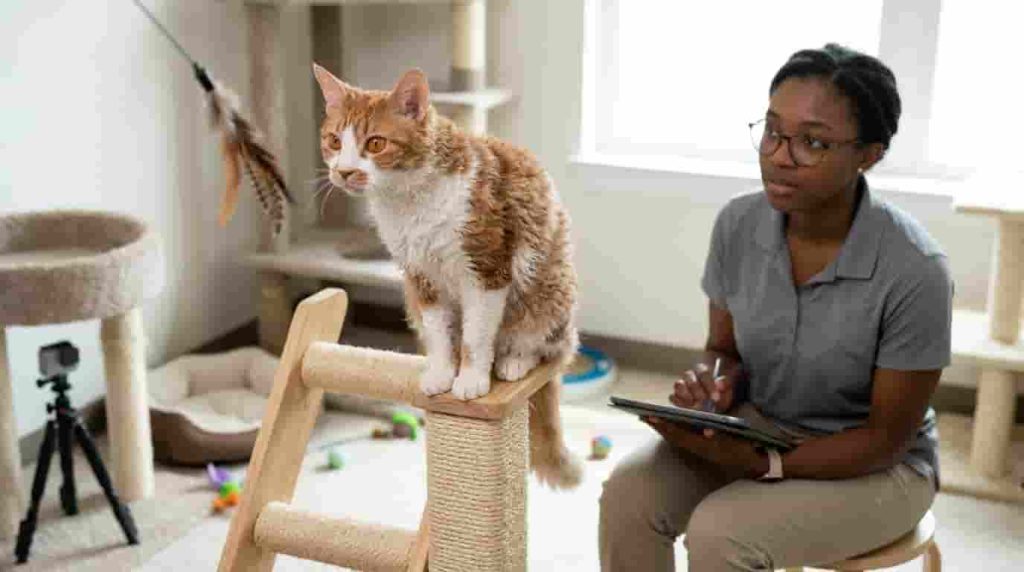
When we look at feline self-recognition through the lens of science, we discover fascinating details about animal cognitive abilities. A study published by the Cornell University College of Veterinary Medicine highlights that cats lack the specific cognitive framework to process permanent visual self-images. Instead, their minds focus heavily on immediate survival needs and territorial boundaries.
This specific focus shapes how they interact with everything in their home environment. For instance, a cat might experience intense Cat Window Stress when it spots an actual outdoor cat invading its perceived territory.
In contrast, the mirror image does not trigger the exact same long term territorial response because it lacks a physical scent. Your cat might hiss initially, but it quickly realizes the reflection poses no real threat.
Therefore, understanding cat behavior requires us to stop projecting human visual experiences onto our pets. Scientists studying pet psychology emphasize that a lack of visual self-recognition is actually normal for most mammals.
Furthermore, recent feline intelligence research shows that cats possess a strong sense of body awareness instead. They know exactly where their limbs are and how to navigate complex spaces gracefully.
They also recognize their own scent marks around the house quite easily. This proves that animal awareness study models must look beyond just vision to measure true intelligence.
| SENSE | HUMAN RELIANCE | CAT RELIANCE |
| Vision | Extremely High | Moderate |
| Scent | Very Low | Extremely High |
| Hearing | Moderate | High |
Understanding Mirror Test in Animals Results
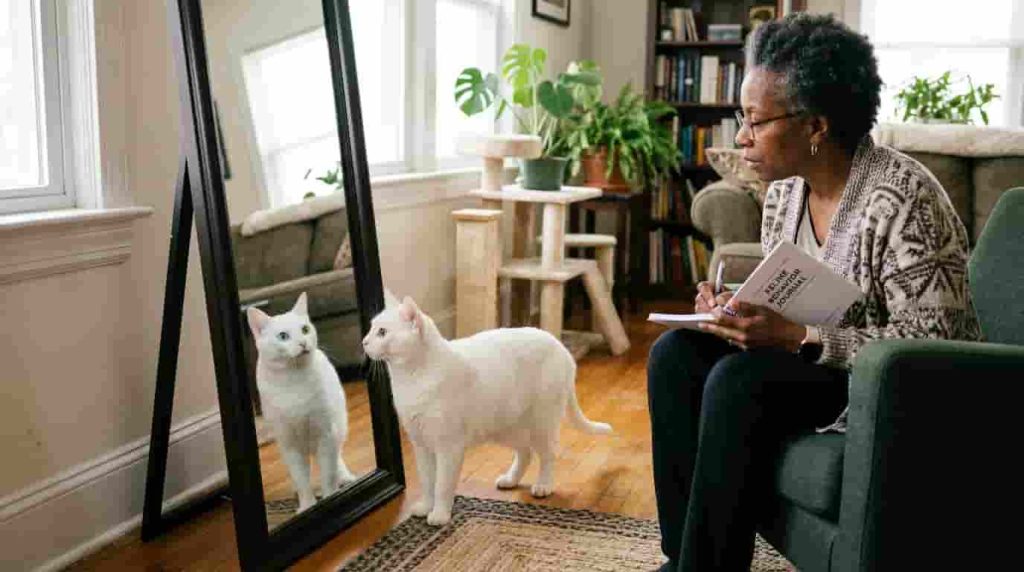
The famous mirror test in animals has been the gold standard for measuring cognitive depth for decades. However, many animal behaviorists now believe this test is unfair to species that do not rely on vision.
Since cats use pheromones to identify friends and enemies, a visual test cannot fully capture their cognitive abilities in pets. They live in a rich olfactory world that humans cannot even begin to imagine.
As a result, a negative mirror test cat result only proves that cats do not use sight as their primary identity tool. It does not mean they lack a deep, internal sense of existence.
How Cat Intelligence Shapes Their Reaction
We can learn a lot about cat intelligence by watching how a cat’s reaction to glass changes over time. First, a young kitten might attack the glass because it thinks another kitten wants to play. Next, the kitten will notice that the reflection lacks a distinct feline scent. Finally, the cat will simply choose to ignore the mirror altogether.
This ability to habituate and stop reacting shows great cognitive flexibility. They learn that the reflection is completely irrelevant to their daily survival.
This smart adaptation is similar to how a cat learns to stop a bad habit through proper environmental training. For example, you can use positive reinforcement during Cat Plant Nibbling training to safely redirect their natural chewing instincts.
Cats quickly figure out which items in the house give them rewards and which items are useless. Because the mirror provides no food, comfort, or threat, your cat smartly decides to ignore it.
This excellent habituation process is a clear sign of high functioning animal cognitive abilities. It proves that understanding cat consciousness requires looking at how they solve daily practical problems.
Do Cats Recognize Themselves in Other Ways?
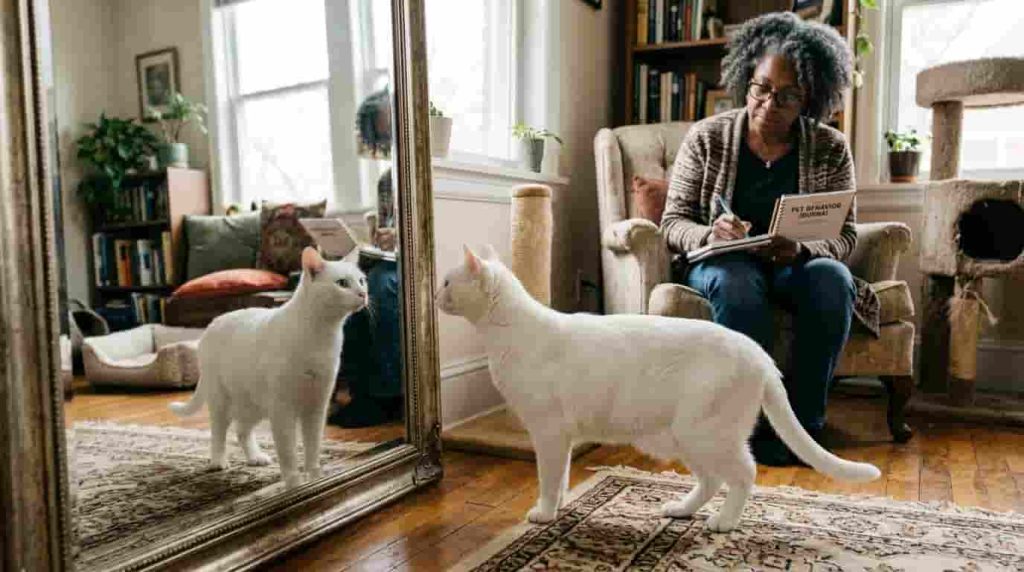
Many owners wonder if cats recognizing themselves happens through scent rather than sight. According to articles on PetMD, cats have an incredibly advanced olfactory system that drives their social lives. They groom themselves to maintain a specific individual scent profile that identifies them.
Therefore, a cat knows its own scent perfectly well when it smells its bedding or favorite toys. This unique form of self-awareness is highly effective for a solitary predator.
They do not need a mirror to tell them who they are because their nose already provides that data. This reality shows why we must expand our definitions of self-awareness in pets.
When a cat rubs its cheeks against your furniture, it leaves behind personal pheromone markers. It is creating a map of its own territory using its body chemistry.
If you want to keep your pet safe, you must protect this environment from household dangers. Owners often invest time into preventing Cat Cord Chewing to keep their smart pets safe from electrical hazards.
A safe environment allows your cat to explore its sensory world without experiencing harmful accidents. By protecting their space, you help them exercise their natural cognitive skills safely.
The Role of Sight in Cat Behavior Research
Traditional cat behavior research often focused too much on how cats respond to human visual cues. Newer studies now look at how cats process movement and light instead of static shapes.
A cat is highly sensitive to the slightest motion because they are natural born hunters. This explains why a sudden movement in a mirror can startle them so easily at first.
However, they quickly realize the movement mirrors their own body exactly. This realization causes them to lose interest because it does not act like real prey.
What an Animal Awareness Study Reveals
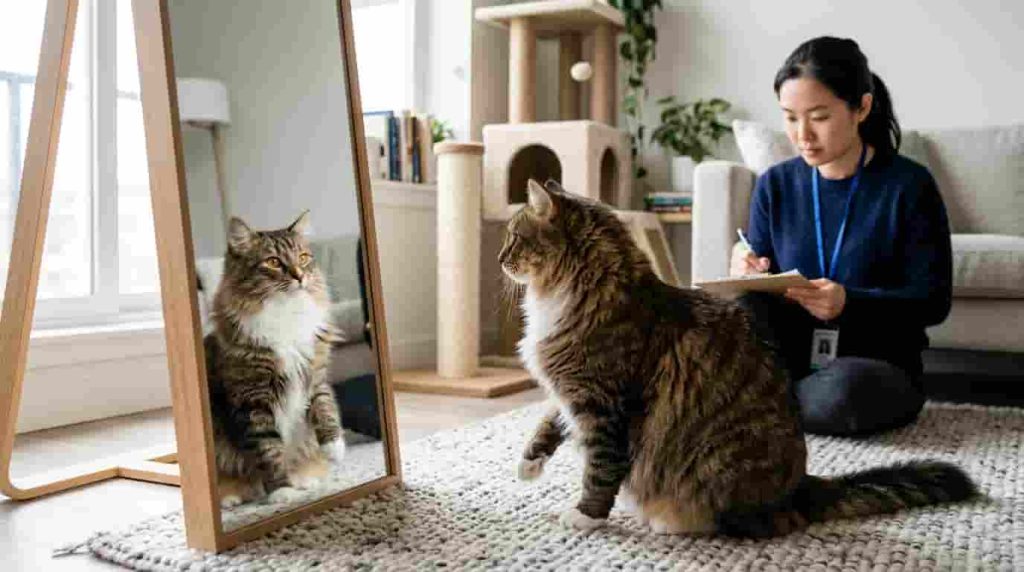
A recent animal awareness study suggests that cats possess a clear concept of agency. Agency means that an animal knows its own actions cause specific things to happen in the environment.
When your cat swats at a toy, it expects the toy to move across the floor. This understanding of cause and effect is a fundamental building block of true intelligence.
Therefore, cat mirror self awareness might be limited visually, but their spatial awareness is excellent. They understand their physical boundaries perfectly as they jump and climb around your home.
Tips for Managing Mirror Anxiety in Cats
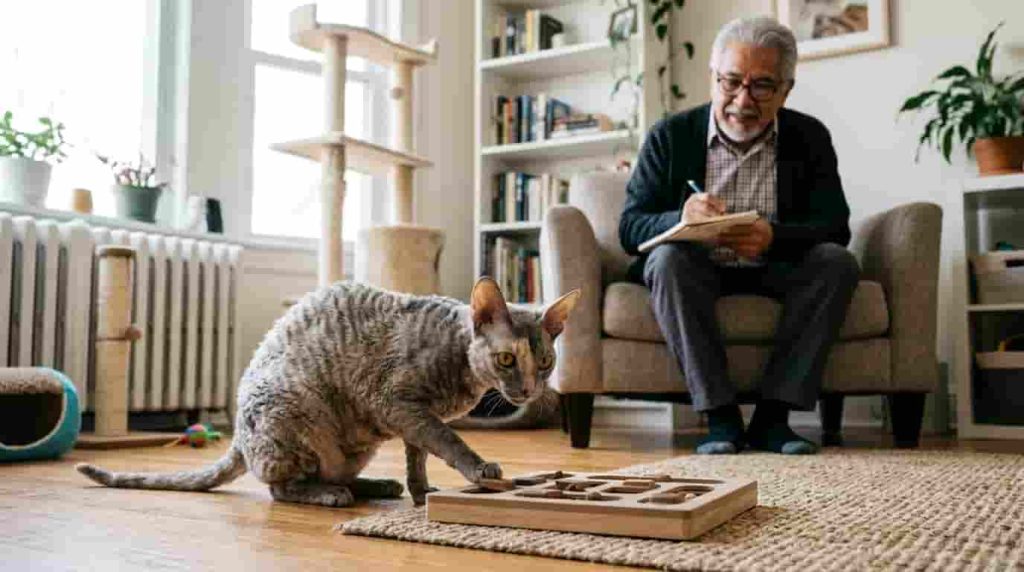
If your pet struggles with cat mirror self awareness, you can take practical steps to help them feel secure. Some cats become highly stressed when they see their own reflection because they think an intruder has arrived.
First, you can cover low hanging mirrors with a towel or a sheet for a few days. This temporary cover gives your stressed pet a chance to calm down completely.
Next, you can move your furniture to block your cat’s direct line of sight to the glass. Finally, try placing treats near the mirror to create a positive association with that specific area.
- Cover low mirrors to reduce anxiety.
- Move furniture to block reflections.
- Use treats to create positive associations.
- Play with your cat near the glass to distract them.
- Apply matte anti glare film to reflective surfaces.
Additionally, you can use synthetic pheromone diffusers to lower overall stress levels in the room. These diffusers mimic the natural comforting scents that cats use to mark safe zones.
Over time, your cat will realize that the mirror area is completely safe and non threatening. This step by step approach relies on proven principles of pet psychology to solve behavioral issues.
Decoding Cat Behavior Studies on Reflections
When we analyze various cat behavior studies, we see a clear pattern in how different ages react. Young kittens display the highest amount of excitement and aggression when facing a mirror.
In contrast, older adult cats usually glance at the glass once and then walk away calmly. This age difference shows that experience plays a huge role in how cats process the world.
An older cat has already learned that reflections cannot be caught or eaten. This learned behavior is a great demonstration of feline intelligence research in action.
It shows that cats store memories of past experiences and use them to guide future choices. They do not waste precious energy on illusions that do not benefit their lives.
Therefore, a calm reaction to a mirror is actually a sign of maturity and wisdom. Your cat has mastered its environment and knows exactly what deserves its valuable attention.
| AGE GROUP | TYPICAL BEHAVIOR | INTENT |
| Kitten | Hissing, Swatting, Play | Investigation |
| Adult | Brief Glance, Ignoring | Habituation |
| Senior | Complete Disinterest | Disregard |
Future Directions in Feline Intelligence Research
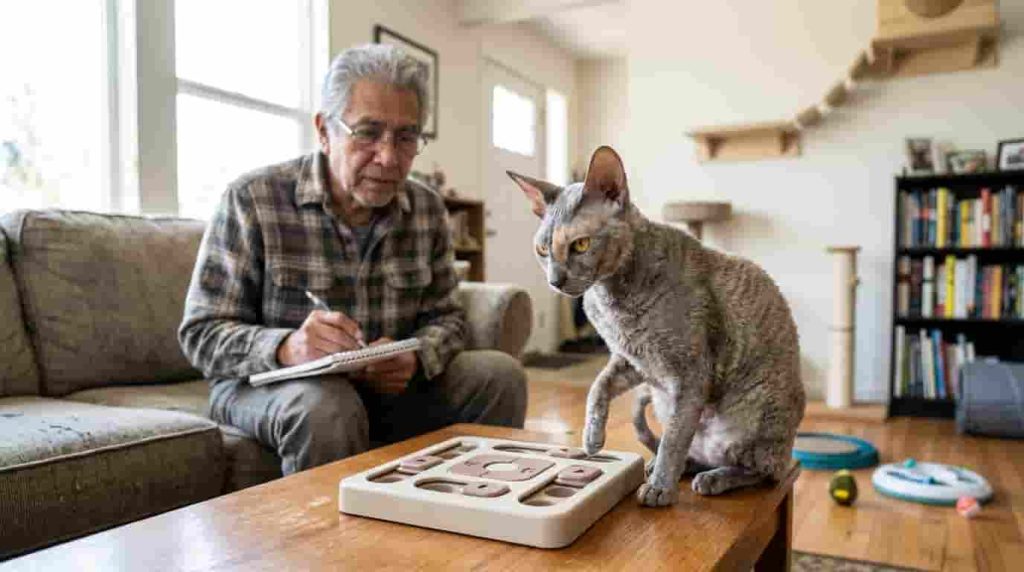
The field of feline intelligence research is expanding rapidly as scientists develop better testing methods. Future studies will likely focus more on acoustic and olfactory mirrors to test animals.
Imagine a test where a cat is presented with its own delayed scent profile instead of a visual image. These innovative tests will give us a much fairer assessment of what cats actually understand.
Until then, we should appreciate cats for the unique sensory creatures they truly are. They do not need to pass human tests to prove they are incredibly smart companions.
Conclusion
In conclusion, cat mirror self awareness remains a unique topic that highlights the differences between human and feline minds. While cats fail the traditional visual test, they possess a deep sense of identity through scent and body awareness.
They use their impressive cat intelligence to navigate the world on their own distinct terms. By understanding their sensory world, we can better appreciate their unique behaviors and reduce their daily stress.
Does your furry friend love looking at the glass, or do they completely ignore it? Please share your personal experiences with cat mirror self awareness in the comments section below!
Frequently Asked Questions
Your cat hisses because it thinks the reflection is a strange, invading cat entering its territory. Since the image lacks a scent, your cat becomes confused and defensive at first.
Cats can see the eyes in the reflection, but they do not understand it represents another animal’s gaze. They usually look away quickly because prolonged eye contact feels like a threat to them.
Yes, most cats eventually learn to ignore mirrors completely after they realize the image poses no danger. This process is called habituation and shows their ability to learn from experience.
No, big cats like lions and tigers also fail the traditional visual test for self-recognition. Just like domestic cats, they rely much more on scent and sound to identify themselves and others.
You should definitely cover low mirrors if your cat shows signs of ongoing anxiety or aggression. Removing the reflection helps your pet feel safe and secure within its own home territory.