

Can Cats Learn Tricks? Easy Tricks and Training Tips for Cats
Introduction: Can Cats Learn Tricks?
Can Cats Learn Tricks? Yes, cats can learn many tricks through repetition, motivation, and positive reinforcement. Although cats do not necessarily learn in the exact same way dogs do, their individual personality, motivation, age, physical ability, and previous experience heavily shape the training process.
From mastering simple commands like sit, high-five, come when called, target touching, and spin to more advanced moves like jumping through a hoop or going to a mat, cats are fully capable of learning. Training is always more effective when sessions are kept short, voluntary, and rewarding. This guide explores the easiest beginner tricks, step-by-step training methods, common mistakes to avoid, rewards, and how basic tricks pave the way for more advanced skills.
Can Cats Learn Tricks?

Cats can learn behaviors that closely resemble tricks by forming cognitive associations between a cue, a behavior, and a consequence or reward. While some assume cats are simply less trainable than dogs, their motivation and learning styles differ. Dogs are often bred for direct human cooperation, whereas cats possess distinct behavioral tendencies. A cat may choose not to perform a known behavior simply because the current reward or situation is unappealing.
Do Cats Learn Tricks Like Dogs?
While dogs and cats approach learning differently, cats can easily learn cues and repeat trained behaviors. Cat training works best when the animal is given a clear, motivating reason to participate voluntarily.
Do Cats Know Tricks?
Cats can learn specific behaviors in response to cues, understanding that a particular action produces a desirable outcome. This does not mean cats conceptualize “tricks” in the human sense, but they readily recognize the value of learned behaviors.
How Cats Learn Tricks?

Positive Reinforcement
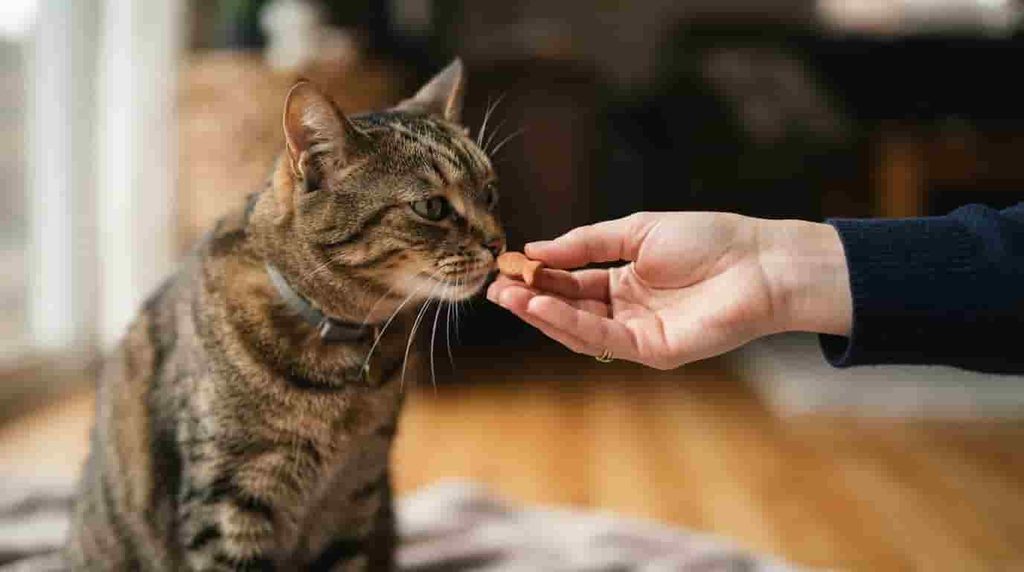
Positive reinforcement involves rewarding the exact behavior you want to see repeated. Effective rewards include small food treats, favorite toys, interactive play, or praise and attention if the individual cat values it.
Timing Matters
Reward the desired action immediately. Delayed rewards can confuse the learning process, making it unclear which action earned the treat. Using a consistent verbal marker like “yes” can help bridge the gap.
Break Tricks Into Small Steps
Never expect a complete behavior immediately. Reward small steps toward the finished trick and gradually increase the requirement over time.
Keep Training Sessions Short
Cats lose interest quickly. Several brief sessions are far more practical than one long session, and you should always stop while the cat is still engaged rather than waiting for frustration to set in.
What Is the Easiest Trick to Teach a Cat?

Target touching and sitting are the best beginner-friendly options because they are easy to break into small steps, simple to reward, and serve as the foundation for more advanced tricks.
How to Teach a Cat to Touch Your Hand or a Target
- Present the target or your hand close to the cat.
- Allow the cat to investigate it naturally.
- Reward a nose touch instantly.
- Repeat until the cat reliably touches the target, then add a verbal cue and gradually move the target farther away.
How to Teach a Cat to Sit
Hold a reward near the cat’s nose, slowly move it upward and slightly back, and reward when the cat naturally lowers its hindquarters. Add the word “sit” once the movement becomes predictable, repeating the exercise in short sessions without ever physically forcing the cat into position.
10 Easy Tricks to Teach Your Cat
1. Sit
Beginner-friendly and serves as a useful foundation for other obedience behaviors.
2. High-Five
Build this from a natural paw movement by rewarding the cat for raising one paw toward your hand.
3. Touch
Teach the cat to touch a hand or target stick with its nose to help guide future training exercises.
4. Come When Called
Start from a short distance using a consistent verbal cue and reward the cat immediately when it approaches.
5. Spin
Use a treat or target to guide the cat in a gentle circle, adding a verbal cue once the movement becomes predictable.
6. Go to a Mat
Reward the cat for stepping onto a designated mat and gradually increase the duration spent resting there.
7. Jump Through a Hoop
Introduce a low, safe hoop without pressure, rewarding movement toward and eventually through it.
8. Fetch
Some cats naturally enjoy retrieving objects; start with a favorite toy and reward the cat for returning it toward you.
9. Stand or Rear Up
Use a treat to encourage a brief, controlled rise while keeping the movement physically comfortable and avoiding overstraining.
10. Ring a Bell or Touch a Button
Teach a target behavior first and reward the cat for interacting with the object, which can evolve into a fun communication game.
How to Train a Cat to Do Tricks Step by Step
- Step 1: Choose the Right Reward: Determine what motivates your individual cat, utilizing appropriately sized treats, toys, or play.
- Step 2: Choose One Behavior: Focus on a single clear behavior rather than teaching multiple unrelated tricks simultaneously.
- Step 3: Find the Natural Movement: Capture and reward movements the cat already performs naturally.
- Step 4: Add the Cue: Introduce a consistent verbal or visual cue once the cat reliably performs the action.
- Step 5: Gradually Reduce the Lure: Stop relying on a visible treat as a guide, using the cue first and rewarding afterward.
- Step 6: Practice in Different Locations: Slowly introduce new, quiet environments and minor distractions.
- Step 7: End on a Success: Finish every session with a behavior the cat already knows well to keep the experience positive.
How to Train a Cat That Does Not Seem Interested

If a cat appears uninterested, it does not mean the cat is unintelligent. The reward may lack appeal, the environment may be too distracting, or the task might be too difficult. Experiment with better rewards, break the first step down into smaller increments, and avoid training immediately after large meals or when the cat is stressed.
Can Cats Learn Tricks at Any Age?
Cats can learn throughout their entire lives. Kittens are curious and adaptable, adult cats readily master new behaviors, and older cats can still learn—though physical limitations, joint comfort, or sensory changes should dictate which tricks are appropriate. If an older cat suddenly struggles with previously easy behaviors, consult a veterinarian rather than assuming stubbornness.
Does Punishment Work When Training Cats?
Punishment has no place in teaching tricks. It creates fear, stress, and confusion rather than helping a cat understand desired actions. Always focus on rewarding correct behavior, and simply reset calmly if the cat makes a mistake without yelling or physical corrections.
How Smart Are Cats When It Comes to Learning Tricks?

Learning tricks requires attention, memory, association, motivation, physical coordination, and problem-solving. While training reveals individual cognitive abilities, it is not a scientific ranking of intelligence. Some training tasks require cats to figure out relationships between actions and outcomes, tying closely into broader feline problem-solving skills, as detailed in Can Cats Solve Problems? Understanding Their Problem-Solving Skills
Can Trick Training Help With Cat Behavior?
Structured daily training sessions provide mental stimulation, strengthen the human-cat bond, and give energetic or curious cats an appropriate outlet for their energy. While training is not a cure-all for medical or behavioral issues, it serves as excellent enrichment when participation remains strictly voluntary.
Can Trick Training Help Cats Learn More Complex Skills?
Simple behaviors serve as building blocks for advanced tasks. For instance, target touching can lead to obstacle navigation, and paw targeting can help cats interact with complex objects. These foundational skills make it possible to teach more advanced feats, such as opening doors safely, as explored in Can Cats Learn to Open Doors? How Smart Cats Figure It Out
Do Cats Remember the Tricks They Learn?
Cats easily retain learned associations and behaviors, though consistency is key to keeping those skills sharp. Performance varies based on context and motivation. Broader feline memory and how cats retain location and environmental awareness over time are further examined in Can Cats Remember Where They Live? How Cats Find Their Way Home
Common Cat Training Mistakes to Avoid

- Training for Too Long: Keep sessions short to prevent burnout.
- Moving Too Quickly: Master one step completely before introducing the next.
- Rewarding Too Late: Deliver treats instantly so the cat associates the reward with the correct action.
- Using Only Food: Tailor the reward to what your cat values most, whether treats, play, or praise.
- Physically Forcing the Cat: Allow the cat to participate entirely on its own terms.
- Expecting Dog-Like Obedience: Remember that cats operate on independent motivational drives.
- Practicing in a Distracting Environment: Start in a quiet, familiar room.
- Ignoring Body Language: Stop immediately if the cat shows stress or fatigue.
Tips for Successful Cat Training
- Keep sessions short and sweet.
- Train in a quiet, low-distraction area.
- Use a high-value reward.
- Deliver rewards immediately following the behavior.
- Maintain consistent verbal and visual cues.
- Break complex tricks down into tiny steps.
- Always end training on a successful note.
- Never force or punish your cat.
Frequently Asked Questions About Teaching Cats Tricks
1. Can cats learn tricks like dogs?
Yes, cats can learn many behaviors through positive reinforcement, though their motivational drivers and training styles differ from dogs.
2. What is the easiest trick to teach a cat?
Sit and target touching are ideal beginner options because they break down into very simple, rewarding steps.
3. Can cats learn tricks at any age?
Yes, cats can learn throughout their lives, provided training is adapted for their age, physical comfort, and individual motivation.
4. Do cats remember tricks they have learned?
Cats retain learned associations, and regular, low-pressure practice helps keep those behaviors reliable.
5. What should I do if my cat refuses to learn a trick?
Never force the behavior. Switch to a more appealing reward, simplify the initial step, or choose a trick that aligns with your cat’s natural instincts.
Conclusion: Can Cats Learn Tricks?
Can Cats Learn Tricks? Yes! Successful training relies on strong motivation, clear cues, repetition, positive reinforcement, short sessions, and respect for individual feline personality. Not every cat will enjoy the exact same tricks, making it best to start small with a basic behavior like sitting or target touching. Beyond simple entertainment, trick training provides valuable mental stimulation and deepens the bond between you and your cat.
What trick has your cat learned, or which trick would you like to teach next?